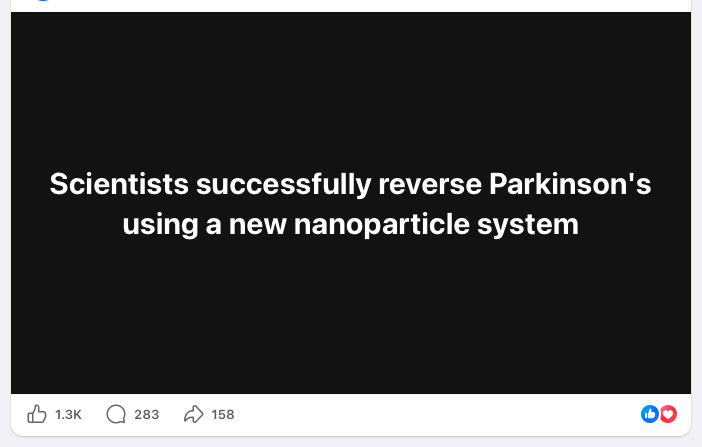
New Parkinson's treatments, miracle cures, and exciting research headlines are everywhere. But how do you know what's legitimate, what's still experimental, and what's simply too good to be true?
We had a really interesting discussion during our recent Parkinson's Disease (PD) Support Group about something that affects nearly everyone living with Parkinson's: How do you separate fact from fiction when it comes to new treatments, potential cures, and the endless stream of health information online?
Whether it's a new medication, a supplement promising to reverse symptoms, an innovative medical device, or a headline announcing a scientific breakthrough, it can be difficult to know what to believe.
And when you're living with a progressive condition like Parkinson's, these claims can be especially compelling. Everyone wants to feel better, maintain their independence, and hold on to hope that something new might make a difference.
Unfortunately, not everything advertised as a breakthrough is supported by good science. Some treatments are genuinely promising but still years away from being available. Others have limited evidence of effectiveness, while some are outright misleading.
The consequences can go beyond disappointment. People may spend hundreds or thousands of dollars on unproven treatments, experience unexpected side effects, or delay care that could actually help them.
Our goal during the discussion wasn't to discourage hope or curiosity. Quite the opposite! We wanted to give everyone the tools to become a more informed consumer of health information.
1. Beware of the Headlines: Is It Really a Parkinson's Breakthrough?
We've all seen attention-grabbing headlines online. Some are based on legitimate scientific discoveries, but the headlines can make the findings sound much more definitive than they actually are.
Consider these examples of the types of claims you might encounter:
"Scientists Discover a Cure for Parkinson's Disease!" — Did researchers actually cure Parkinson's in humans, or did they identify a promising mechanism in laboratory experiments?
"New Stem Cell Treatment Reverses Parkinson's Symptoms!" — Stem cell research is exciting, but experimental results are not the same as an established treatment.
"This Natural Supplement Can Stop Parkinson's Progression!" — What clinical evidence supports the claim? Was the supplement compared against a placebo?
"Red Light Therapy Could Transform Parkinson's Treatment!" — Are the results from a large, well-designed clinical trial, or just a handful of participants?
"Doctors Don't Want You to Know About This Miracle Treatment!" — This is a major warning sign. Legitimate researchers generally want their discoveries independently evaluated and shared.
The important thing to understand is that a headline may contain a grain of truth while still creating unrealistic expectations.
For example, researchers may discover that a particular treatment improves movement in mice with Parkinson-like symptoms. That's exciting, but it doesn't mean the treatment will work in humans, that it's safe, or that it will ever become an approved therapy.
Our advice: Read beyond the headline. Find out what was actually studied, who was studied, and what the researchers really concluded.
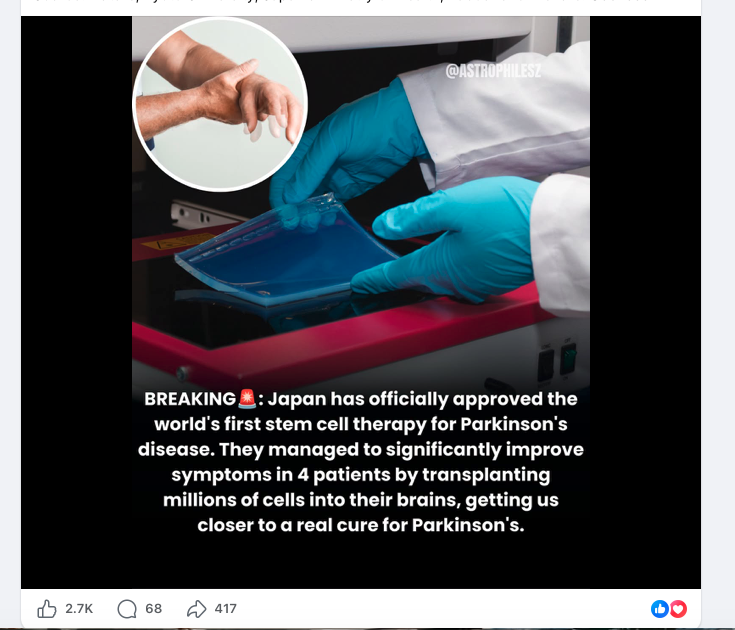
2. Five Questions to Ask Before Believing a New Treatment Claim
During our support group, we reviewed five simple questions everyone can use when evaluating health information.
Question 1: Who is providing the information?
Is the information coming from a respected research institution, hospital, medical journal, or Parkinson's organization?
Or is it coming from a company selling a product, a social media influencer, or an advertisement?
That doesn't automatically mean the information is wrong, but it should influence how critically you evaluate the claims.
Question 2: What is the scientific evidence?
Not all evidence is created equal.
A personal testimonial describing how someone's tremor disappeared after using a product may be compelling, but it doesn't prove the treatment works.
Symptoms can fluctuate, placebo effects are real (and often particularly strong in people with Parkinson’s Disease), and people may be using multiple treatments simultaneously.
Stronger evidence comes from well-designed clinical studies involving larger groups of participants, appropriate comparison groups, and independently reviewed results.
Question 3: What exactly is the treatment supposed to do?
This distinction is incredibly important.
A treatment that improves tremor, walking, sleep, or stiffness is not necessarily slowing the progression of Parkinson's.
There are three very different claims:
Symptom management: Helping someone feel or function better.
Disease modification: Slowing or stopping the underlying disease process.
A cure: Eliminating the disease itself.
Currently, there is no established cure for Parkinson's disease. However, there are many evidence-based treatments that can help manage symptoms and improve quality of life.
Question 4: Is it FDA-approved or still experimental?
Just because something is being studied doesn't mean it has been proven safe or effective.
Likewise, a treatment may be FDA-approved for one medical condition but not for Parkinson's disease.
Be particularly cautious when companies use terms like "FDA registered" or "FDA listed." These do not necessarily mean a product has received FDA approval for the condition being advertised.
Question 5: What are the risks and costs?
Before trying something new, consider:
Could it interact with my Parkinson's medications?
Are there potential side effects?
How much will it cost?
Is there good evidence that the benefits justify the expense?
Am I being encouraged to stop or replace a treatment that is already helping?
Remember, "natural" does not automatically mean safe, and "expensive" does not mean effective.
3. Understanding Clinical Trials: What Do Phase 1, 2, and 3 Really Mean?
One of the most helpful things we discussed was how new treatments make their way from the laboratory to patients.
When you hear that a new Parkinson's medication is entering clinical trials, it's important to understand where it is in the research process.
Preclinical Research: The Starting Point
Researchers investigate a potential treatment in laboratory experiments and sometimes animal models. This helps determine whether the treatment warrants further investigation.
Phase 1: Is It Safe?
Researchers study safety, dosage, and potential side effects in a relatively small group of participants.
A successful Phase 1 trial does not establish that a treatment works.
Phase 2: Does It Show Signs of Working?
Researchers begin looking more closely at whether the treatment provides the intended benefits while continuing to monitor safety.
Results may be promising, but larger studies are usually needed.
Phase 3: Does It Really Work?
These are generally larger studies designed to confirm effectiveness, assess risks, and compare the treatment with existing therapies or a placebo.
Successful results may support an application for FDA approval.
Phase 4: What Happens After Approval?
Researchers may continue studying a treatment after approval to learn more about long-term safety, effectiveness, and its use in broader populations.
Not every treatment follows this exact pathway, and devices and rehabilitation interventions may have different regulatory requirements.
The big takeaway?
A treatment being in a clinical trial is exciting, but it is not the same thing as a treatment being proven effective.
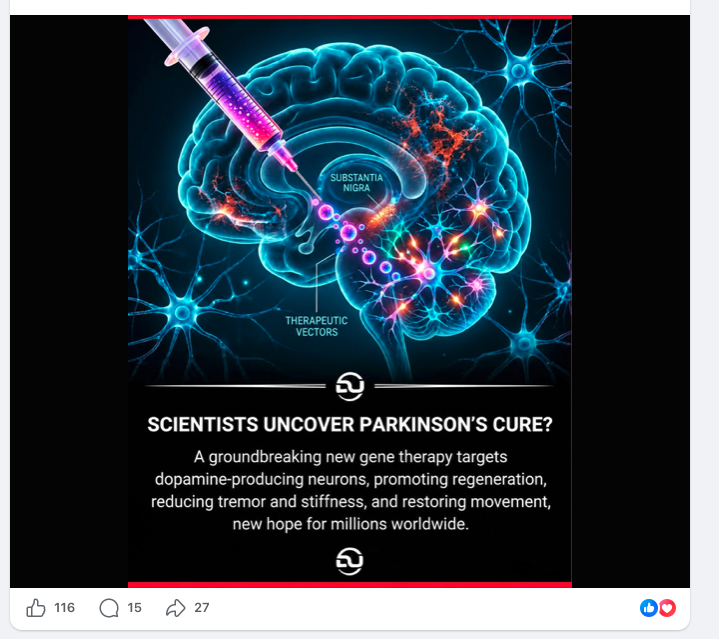
4. What About Stem Cells, Supplements, and New Technologies?
Some of the most exciting areas of Parkinson's research involve stem cell therapies, gene therapies, new medication delivery systems, and innovative technologies.
These approaches deserve scientific investigation, but they also illustrate why understanding the evidence is so important.
Stem Cell Therapies
Researchers are investigating whether replacing dopamine-producing cells might improve symptoms of Parkinson's disease.
This is an exciting area of research, but patients should be especially cautious about commercial clinics offering expensive stem cell treatments outside appropriately regulated clinical trials.
The FDA has warned consumers about unapproved regenerative medicine products, including products marketed for neurological conditions such as Parkinson's.
It's also important to remember that Parkinson's is a complex disease, and not everyone develops it for the same reasons. Research from the Parkinson's Foundation's PD GENEration study has found that approximately 13% of participants have an identifiable genetic variant associated with Parkinson's disease. This reminds us that while genetic discoveries and emerging therapies offer tremendous promise, there is unlikely to be a single treatment that works for everyone. Understanding the underlying causes of Parkinson's—and how they differ from person to person—is an important part of developing more targeted and effective treatments.
Supplements and Alternative Treatments
You may encounter advertisements for high-dose vitamins, antioxidants, herbal products, or other supplements claiming to protect dopamine-producing neurons, improve Parkinson's symptoms, or even slow disease progression.
Some of these products have legitimate scientific research behind them, while others rely heavily on testimonials and marketing. The important question is whether the research actually supports the claims being made.
Here are several supplements that frequently come up in conversations about Parkinson's disease:
Mucuna Pruriens (Velvet Bean)
Mucuna is a tropical plant that naturally contains levodopa, the same active ingredient used in one of the most effective prescription medications for Parkinson's disease.
Some small clinical studies have demonstrated improvements in motor symptoms, which makes sense because Mucuna contains levodopa. A 2025 systematic review identified five clinical trials involving just 108 participants, with some promising results.
However, there are important concerns. Unlike prescription medications, supplements may contain inconsistent amounts of levodopa, making dosing unpredictable. They can also cause medication-related side effects, including nausea, involuntary movements, and changes in blood pressure.
The takeaway: Mucuna isn't necessarily a scam, but it isn't a proven cure or a safer replacement for prescription levodopa. Its long-term safety and effectiveness remain uncertain, and it should not be added to a Parkinson's medication regimen without medical supervision.
Vitamin C and Other Antioxidants
You've probably heard that antioxidants help protect cells from damage. Because oxidative stress is believed to contribute to Parkinson's disease, researchers have investigated whether antioxidants such as vitamins C and E could help protect dopamine-producing neurons.
Unfortunately, while the biological theory is interesting, clinical studies have not established that taking high-dose vitamin C or other antioxidant supplements slows Parkinson's progression.
Vitamin C may have a role in certain medication-absorption situations, but that is very different from protecting the brain against Parkinson's.
The takeaway: Eating a healthy diet rich in fruits and vegetables is beneficial, but there is no convincing evidence that high-dose vitamin C supplements prevent or reverse Parkinson's disease.
Probiotics and Gut Health
This is a particularly interesting area of research because we now recognize an important relationship between the gastrointestinal system, the gut microbiome, and Parkinson's disease.
Constipation is extremely common in Parkinson's and can sometimes develop years before the more recognizable movement symptoms.
Several clinical studies have found that certain probiotics may improve constipation, bowel movement frequency, and gastrointestinal symptoms in people with Parkinson's.
However, researchers have not established that probiotics can slow, prevent, or reverse Parkinson's disease. Studies investigating possible effects on movement and other symptoms remain preliminary.
The takeaway: Probiotics may be useful for managing constipation in some people with Parkinson's, but improving gut health does not necessarily mean changing the underlying disease process. Different probiotic formulations may also have different effects.
Coenzyme Q10 (CoQ10)
CoQ10 became popular because of its role in cellular energy production and its potential antioxidant properties.
Early studies suggested it might protect neurons and slow Parkinson's progression. Unfortunately, when researchers conducted a much larger Phase 3 clinical trial involving 600 participants, they found no evidence of clinical benefit.
This is actually a great example of why we need large, well-designed clinical trials before declaring something a breakthrough.
The takeaway: CoQ10 initially looked promising, but stronger research failed to demonstrate that it slows Parkinson's disease.
High-Dose Vitamin B1 (Thiamine)
High-dose thiamine has gained attention through online communities and small observational studies reporting improvements in fatigue and movement symptoms.
However, the research remains limited, and high-quality clinical evidence has not established that high-dose thiamine improves Parkinson's symptoms or slows progression.
The takeaway: More research is needed before recommending high-dose thiamine as a Parkinson's treatment. Correcting an actual vitamin deficiency is important, but that is different from taking large doses to treat Parkinson's disease itself.
It's important to recognize that a supplement can have a legitimate medical use without being a treatment for Parkinson's disease itself.
For example, probiotics might help constipation, and vitamin supplementation may be appropriate for someone with a documented deficiency. Neither necessarily means the supplement protects dopamine-producing neurons or slows disease progression.
And remember, natural doesn't always mean safe. Supplements can interact with medications, cause side effects, and vary in purity and potency.
Before investing in an expensive supplement or adding something new to your routine, talk with your neurologist or pharmacist and ask whether the benefits are supported by good-quality research.
Our advice: Be curious about new discoveries, but don't confuse an interesting scientific theory with a proven treatment.
Red Light Therapy and Wearable Devices
Emerging technologies, including photobiomodulation (red or near-infrared light therapy) and wearable devices, are generating considerable interest in the Parkinson's community.
Red Light Therapy (Photobiomodulation)
Researchers are investigating whether specific wavelengths of red or near-infrared light might influence cellular function and potentially improve Parkinson's symptoms. Although some small studies have reported encouraging findings, larger, well-controlled clinical trials are needed to establish meaningful benefits, determine appropriate treatment protocols, and evaluate long-term safety.
Wearable Devices, Including BeechBand
Another emerging area involves wearable technologies designed to influence sensory input or provide rhythmic stimulation. One example is the BeechBand, a wearable device being explored for symptoms such as tremor, freezing of gait, anxiety, and sleep disturbances.
Some individuals have reported improvements while using devices like BeechBand, and these experiences are certainly worth investigating. However, personal testimonials and individual responses are not the same as scientific proof. At this time, there is insufficient high-quality clinical evidence to conclude that BeechBand reliably improves Parkinson's symptoms, slows disease progression, or provides lasting therapeutic benefits.
5. Where Can You Find Information You Can Trust?
Fortunately, there are several excellent resources available to help you investigate treatments and research claims.
ClinicalTrials.gov — www.clinicaltrials.gov
This is a searchable database of clinical research studies.
You can search for Parkinson's disease, a particular medication, or a treatment you're curious about.
Look for the study's phase, recruitment status, sponsor, and available results.
Remember that a study being listed does not mean the treatment has been proven effective or endorsed by the government.
U.S. Food and Drug Administration — www.fda.gov
The FDA provides information about approved medications, medical devices, safety warnings, and potentially misleading treatment claims.
Its Drugs@FDA database can help you determine whether a medication is approved and for what purpose.
Parkinson's Foundation — www.parkinson.org
An excellent resource for understandable information about Parkinson's symptoms, treatments, research, exercise, and clinical trials.
Michael J. Fox Foundation — www.michaeljfox.org
Provides research updates, information about emerging treatments, and resources for people interested in participating in clinical studies.
National Institutes of Health — www.nih.gov
Offers reliable medical information and access to scientific research.
These resources are a great starting point before spending money on a treatment or making changes to your healthcare routine.
6. Don't Overlook the Treatments We Already Know Can Help
With so much attention focused on finding a cure, it's easy to overlook the evidence-based interventions available right now.
While we continue to hope for breakthroughs that can slow, stop, or reverse Parkinson's disease, there are meaningful steps people can take today to improve their quality of life.
In fact, the American Physical Therapy Association (APTA) published a comprehensive Clinical Practice Guideline (CPG) for the Physical Therapist Management of Parkinson Disease in 2022, reviewing the scientific evidence and identifying interventions that have demonstrated meaningful benefits for people living with Parkinson's.
The guideline provides strong recommendations supported by high-quality evidence for several types of exercise and rehabilitation, including:
Aerobic exercise: Moderate- to high-intensity cardiovascular exercise to improve endurance, motor symptoms, and functional mobility.
Resistance training: Strengthening exercises to improve muscle strength, power, physical function, and quality of life.
Balance training: Exercises targeting postural control, stability, balance confidence, and mobility.
Gait training: Interventions designed to improve walking speed, stride length, mobility, and balance.
External cueing and movement strategies: Techniques using visual, auditory, or other cues to improve walking and address freezing of gait.
Task-specific training: Practicing everyday movements and activities to improve functional performance.
Community-based exercise: Participating in ongoing exercise programs to support physical function, symptom management, and quality of life.
These recommendations aren't based on testimonials or promising early laboratory findings. They're based on systematic reviews of published clinical research.
The guideline also emphasizes the importance of ongoing exercise, individualized treatment, and an integrated healthcare approach.
Beyond exercise, people living with Parkinson's can benefit from:
Working with a neurologist, ideally a movement disorder specialist, to optimize medications and symptom management.
Working with physical and occupational therapists who understand Parkinson's disease.
Addressing speech, swallowing, sleep, and other non-motor symptoms with appropriate healthcare professionals.
Staying socially connected through community programs and support groups.
Perhaps the most important takeaway is that you don't have to wait for the next big scientific breakthrough to take meaningful action.
Exercise and rehabilitation can make a significant difference in mobility, confidence, daily function, and quality of life. While exercise has not been conclusively proven to stop or reverse Parkinson's disease progression, its benefits for managing symptoms and maintaining function are well established.
At Healthy Aging Physical Therapy, we use these evidence-based recommendations to guide our Parkinson's rehabilitation programs, helping individuals build exercise routines that are safe, appropriately challenging, and sustainable over time.
The best treatment isn't necessarily the newest or most expensive. Sometimes it's the one supported by decades of research that you can start benefiting from today.
7. Stay Curious, Stay Hopeful, and Ask Questions
Perhaps the most important message from our support group discussion was this:
You don't have to choose between being hopeful and being skeptical. You can be both.
It's exciting to hear about new discoveries, and there is every reason to support continued Parkinson's research.
But hope shouldn't require spending thousands of dollars on unproven treatments or believing promises that sound too good to be true.
The next time you encounter an exciting Parkinson's headline, pause and ask:
Who is making this claim? What is the evidence? Has it been tested in people? Is it approved? What are the potential risks?
And don't hesitate to bring the information to your neurologist, physical therapist, or other trusted healthcare professional.
We love having these conversations in our Parkinson's Support Groups because sharing information, asking questions, and learning together helps everyone become a more confident advocate for their own health.
Stay curious. Ask questions. Check the science. And above all, stay hopeful—but make sure your hope is grounded in good information.
At Healthy Aging Physical Therapy, we specialize in helping older adults and individuals living with neurological conditions maintain mobility, independence, and quality of life. Our outpatient physical and occupational therapy services are provided directly in patients' homes throughout communities north and west of Boston.
Interested in learning more about Parkinson's-specific exercise, rehabilitation, or our community programs? Visit our Parkinson’s Disease Page or contact us at 617-398-4508.