Healthy Aging Physical Therapy Monthly Blog
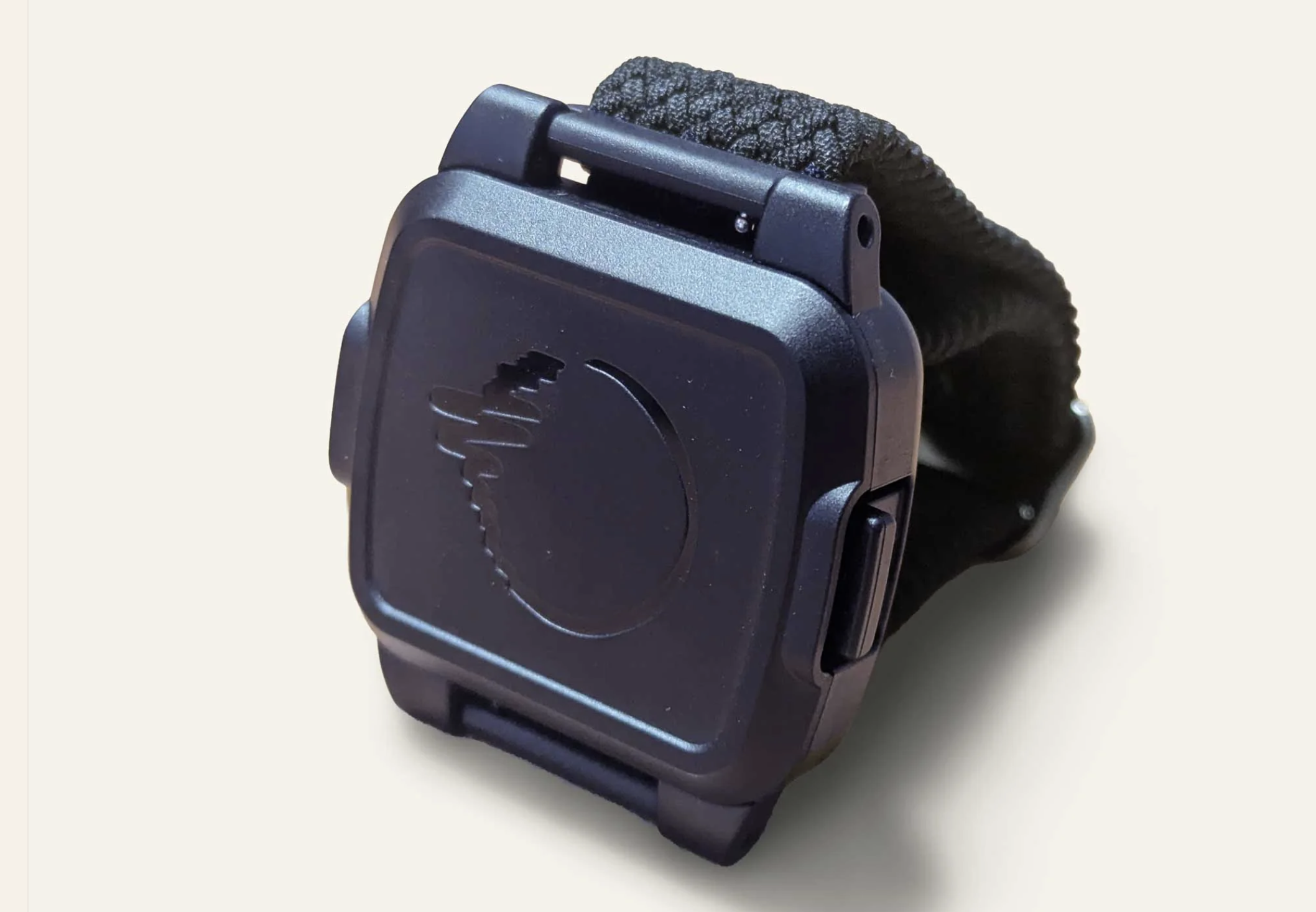
Curious About the BeechBand? Give one a try with HAPT!
Curious about the BeechBand for Parkinson’s? Learn how it works, what users report, and how Healthy Aging Physical Therapy patients can trial a BeechBand before deciding if it’s right for them.
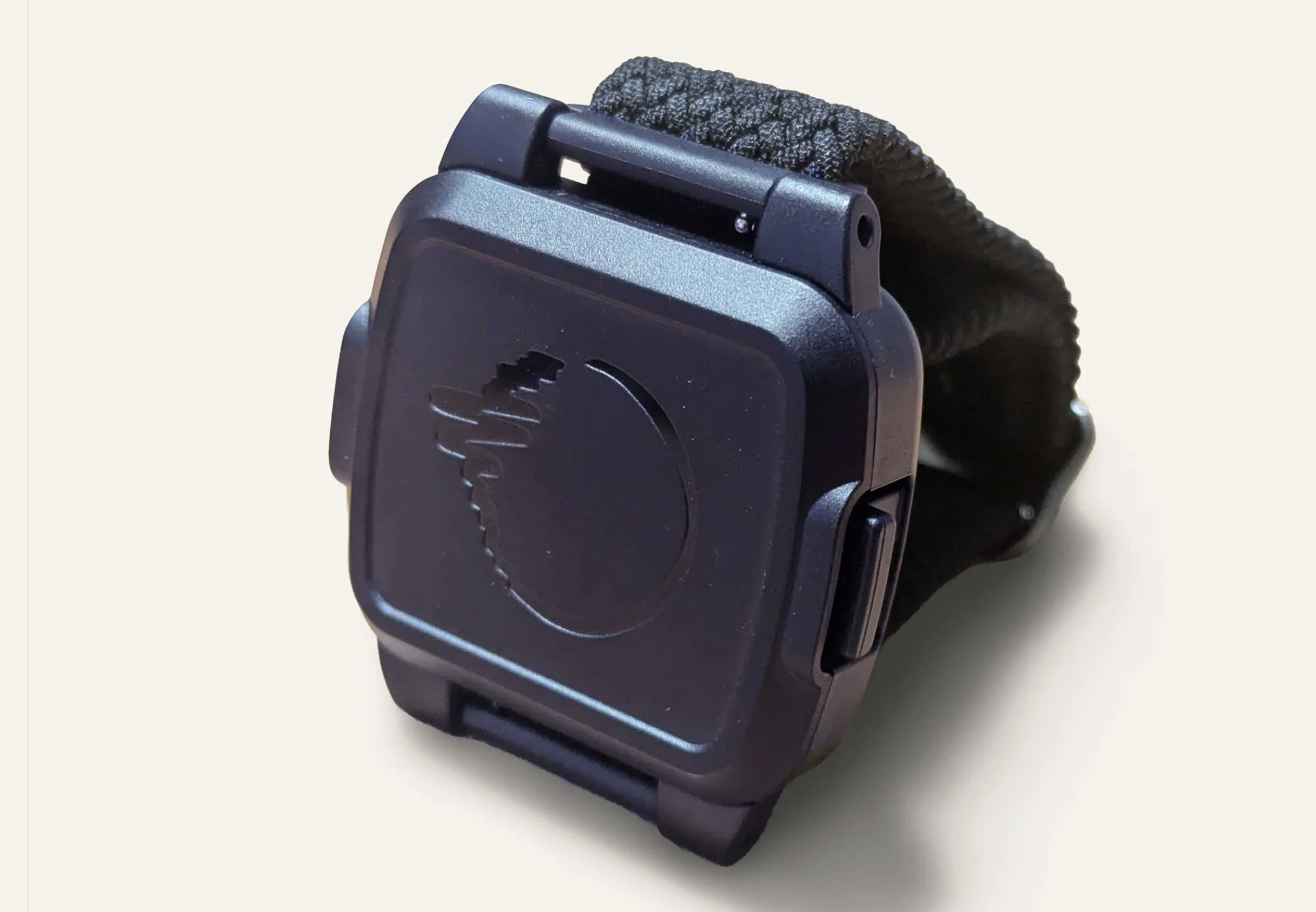
When I attended the World Parkinson Congress this past May, one of the devices that caught my attention was the BeechBand. You may have seen BeechBands online, heard about them in one of your Parkinson’s support groups, or maybe you’ve even tried one yourself. Fortunately, I had the chance to connect with the BeechBand team while I was at the Congress, and they graciously offered to set us up with trial units so our patients could experience them for themselves.
So, what exactly is a BeechBand, and why is everyone talking about it? Let’s get into it.
What Is a BeechBand?
The BeechBand is a small wearable device that provides continuous, gentle mechanical vibration, described by the company as “subconscious vibrotactile stimulation.” Unlike a smartwatch or other connected wearable, the BeechBand does not use Wi-Fi, Bluetooth connectivity, or magnets. The vibration itself is mechanical rather than electrical.
BeechBand’s explanation is that the rhythmic vibration provides a calming sensory signal to the nervous system, and that this could potentially affect movement, anxiety, and other symptoms. The device actually grew out of founder Carl Beech’s experience using a rhythmic tapping technique for his own Parkinson’s symptoms; the wearable was developed as a way of providing that rhythmic input continuously without the person having to consciously perform the tapping.
What can it Help With?
This is one of the big questions — and right now, there isn’t enough research to predict exactly who will respond to the BeechBand or what changes an individual person might experience. Based on feedback BeechBand has collected from people using the device, some of the most commonly reported changes have been in:
Tremor
Anxiety
Speech
Swallowing
Balance and walking
Freezing of gait
Sleep
For our patients with Parkinson’s, we’re particularly interested in whether the BeechBand might make a noticeable difference in things like tremor, freezing, walking and balance, sleep, or anxiety that may be affecting movement and everyday activities.
The important thing to remember is that everyone responds differently. Some people report noticeable changes, while others may notice little or no benefit. That’s exactly why we like the idea of a trial — it gives you the opportunity to find out whether the BeechBand makes a meaningful difference for you.
What Does BeechBand's Data Show?
While formal clinical research is still needed, BeechBand has collected feedback from people who have used the device, and the results are certainly interesting.
According to BeechBand's customer surveys, approximately 75–80% of respondents have reported noticing some type of positive change. About 25% report noticing a change very quickly, while for many others it may take several weeks of consistent use.
BeechBand has also reported higher rates of perceived benefit among people who use the device consistently. In information shared with our team, approximately 85% of respondents who wore the BeechBand for more than 8 hours per day for at least 8 weeks reported a benefit.
Those numbers sound promising, but they need to be interpreted appropriately. These are self-reported customer experiences, not the results of a randomized or controlled clinical trial. They do not yet know exactly who is most likely to respond, which symptoms are most likely to improve, or how much of a change someone might experience.
How Long Does it Take to Work?
Some BeechBand users report noticing a difference very quickly, but for many people, changes are much more gradual. BeechBand currently recommends wearing the device consistently for about 8 hours per day and giving it up to 12 weeks before deciding whether it is making a meaningful difference.
That’s one of the reasons we wanted to offer an extended trial to our patients. We want you to have enough time to incorporate the BeechBand into your normal routine and pay attention to whether anything actually changes — whether that's your walking, freezing, tremor, balance, sleep, anxiety, or another symptom we're monitoring together.
And if you try it consistently and don't notice a difference? That's important information too. The BeechBand doesn't work for everyone, and our goal is to help you determine whether it is useful for you BEFORE you go and purchase one.
Who Can Safely Use a BeechBand?
The BeechBand trial is available to established Healthy Aging Physical Therapy patients when the patient and treating clinician determine that a trial may be appropriate.
Because this is an emerging device, safety comes first.
For our trial program, patients with epilepsy or a seizure disorder will not participate. Patients with a pacemaker or Deep Brain Stimulation (DBS) will need approval from their medical provider before beginning a trial.
The manufacturer also reports that a small percentage of users have experienced temporary nausea or dizziness when first using the device. Patients participating through HAPT should let their therapist know about any new or worsening symptoms while using the band.
How the HAPT BeechBand Trial Works
Since we only have a limited number of BeechBands available, patients participating in the trial program will complete a lending agreement and waiver and provide a $100 refundable deposit. Your deposit will be returned when the BeechBand is returned to Healthy Aging Physical Therapy.
We recommend giving the BeechBand at least one month of consistent use before deciding whether it’s making a difference. Patients are welcome to continue their trial for up to 12 weeks, or until they are discharged from therapy, whichever comes first.
We want you to have enough time to incorporate the BeechBand into your daily routine and determine whether it provides a meaningful benefit for you.
Interested in Trying One?
If you’re currently working with Healthy Aging Physical Therapy and think a BeechBand might be worth exploring, ask your PT or OT about our BeechBand Trial Program.
Your therapist can help determine whether you may be an appropriate candidate, identify what symptoms or functional changes would be useful to monitor, and help you evaluate whether you are experiencing a meaningful difference.
Not currently a HAPT patient?
Healthy Aging Physical Therapy provides specialized in-home physical and occupational therapy for older adults and people living with Parkinson’s disease, balance and gait disorders, vestibular conditions, and other complex neurologic and medical conditions.
If you’re interested in working with our team, please reach out!
Disclaimer: The BeechBand is an emerging device and is not a substitute for medical care or evidence-based rehabilitation. Healthy Aging Physical Therapy does not guarantee that use of the BeechBand will improve any symptom or medical condition. Reported benefits discussed above are based primarily on anecdotal reports and manufacturer-collected user feedback rather than published clinical research.
Healthy Aging Physical Therapy has no financial relationship with BeechBand and receives no compensation, commission, referral fee, or other financial benefit from the sale of BeechBands. We are making a limited number of trial devices available solely as a courtesy to our patients so they can determine for themselves whether the device provides a meaningful benefit.
Participation in the HAPT trial program is subject to clinical screening, device availability, and applicable safety requirements.
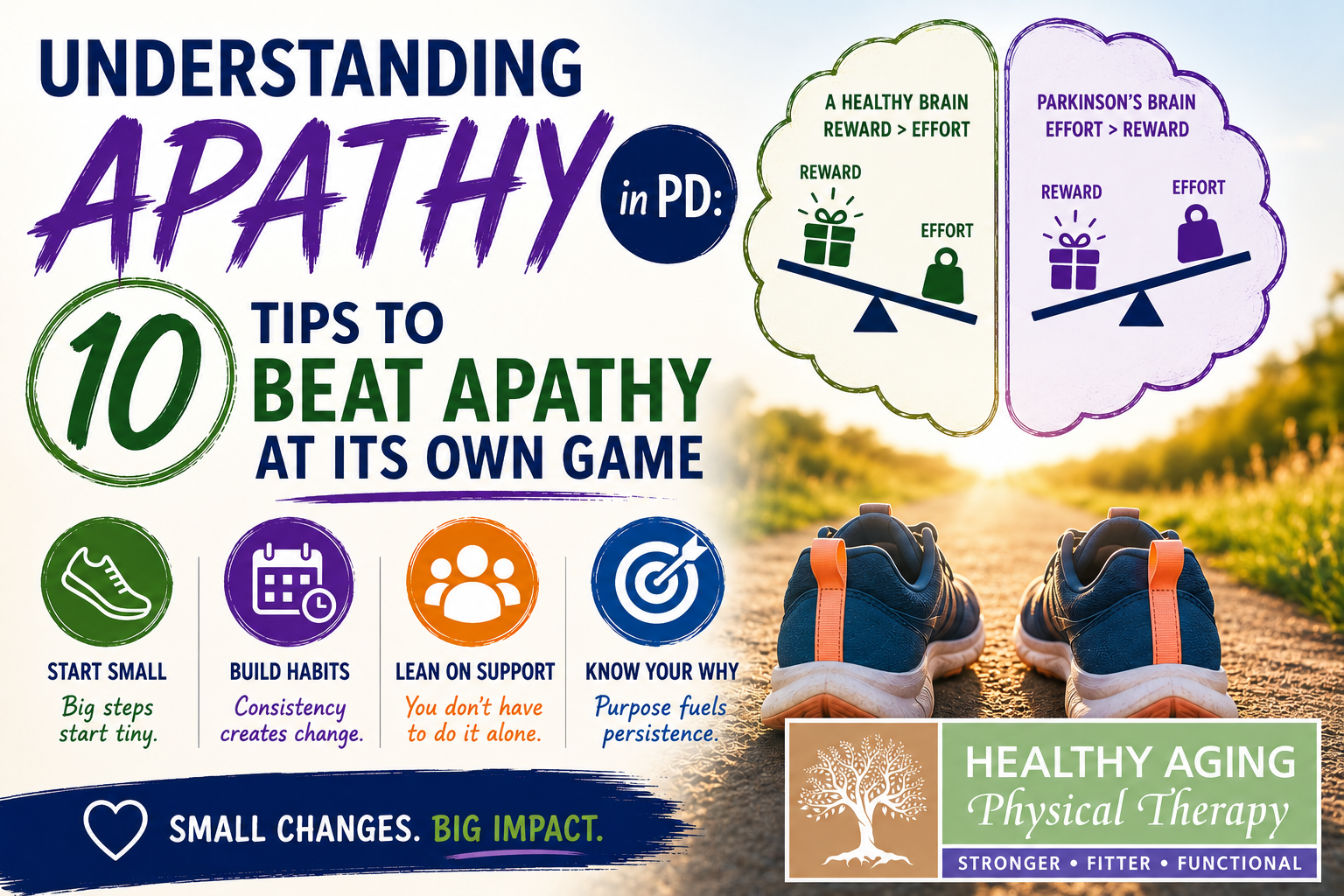
Understanding Apathy in PD: 10 Ways to Beat Apathy at Its Own Game
Discover why apathy in Parkinson's disease is not laziness, but a neurological symptom that changes how the brain calculates effort and reward. Learn the science behind Parkinson's-related apathy and 10 practical, evidence-informed strategies to overcome it and stay engaged in exercise, social activities, and daily life.
When I think about apathy, I picture my now 15-year-old daughter as a toddler. Back then, whenever I asked her to do something she didn't want to do, her response was almost always the same:
"Don't wanna."
Pick up your toys? Don't wanna.
Put on your shoes? Don't wanna.
Go to dance class and leave mom behind? Definitely don't wanna.
Fortunately, she eventually outgrew that stage. But when I think about apathy in Parkinson's disease, I often think about that same simple response — not because people with Parkinson's are acting like toddlers, and certainly not because they're being stubborn or difficult, but because from the brain's perspective, apathy can sometimes be just that simple.
The Parkinson's brain looks at an activity — even one that is important, meaningful, or enjoyable—and responds with a very quick internal calculation:
"Don't wanna."
The challenging part is that this isn't a response you can always reason with. When we don't understand apathy, we often default to motivational strategies that work for people without Parkinson's disease. We remind people that exercise is good for them. We tell them their physical therapist recommended it. We encourage them to try harder, stay active, or think positively. All of those statements are logical, and all of them may be true. Unfortunately, apathy is not a problem of logic.
Apathy is a neurobiological brain problem - and it is an incredibly common and consistent non-motor symptom of Parkinson’s Disease.
Because of that, apathy can create frustration for everyone involved. Care partners may feel ignored or dismissed. Adult children may worry that their parent is giving up. Healthcare providers can spend months educating someone about exercise, medication management, or healthy habits only to see little follow-through. Meanwhile, the person with Parkinson's often feels guilty, ashamed, or misunderstood because they know what they should be doing but struggle to get started.
The result is that everyone is working hard, but they're working against a barrier they don't fully understand.
The good news is that once we understand the neurobiology behind apathy — what it is, why it happens, and how Parkinson's changes the brain's motivation systems — we can start to work around it instead of against it. Understanding apathy gives us the KEYS to beating apathy at its own game.
What Is Apathy?
Apathy is one of the most common non-motor symptoms of Parkinson's disease, affecting an estimated 20–50% of people living with Parkinson's and becoming more common as the disease progresses. Despite how frequently it occurs, it is also one of the most misunderstood symptoms.
Apathy is often mistaken for laziness, depression, lack of effort, or lack of interest. In reality, it is none of those things.
While depression is characterized by sadness, hopelessness, or loss of pleasure, apathy is primarily a disorder of motivation and initiation. People with apathy often still care deeply about their families, hobbies, health, and future. They may want to exercise, attend social events, participate in therapy, or spend time with friends. The challenge is not that they don't care. The challenge is that turning intention into action has become significantly harder.
One of the most helpful ways to understand apathy is to think of it like a Reward vs. Effort Seesaw.
In a healthy brain, the anticipated reward of an activity generally outweighs the effort required to do it. The brain looks at an activity and thinks, "Going for a walk will feel good," or "I'll enjoy seeing my friends," or "Exercise is worth the effort." The reward side of the seesaw stays high, making it easier to get started.
Parkinson's disease can alter that internal cost-benefit calculation. Researchers increasingly believe that apathy reflects changes within the brain's motivation circuits, many of which rely on dopamine and related neurotransmitter systems. As those circuits change, the brain begins to overestimate effort and underestimate reward. The seesaw flips. Activities that once felt worthwhile now feel burdensome before they've even begun.
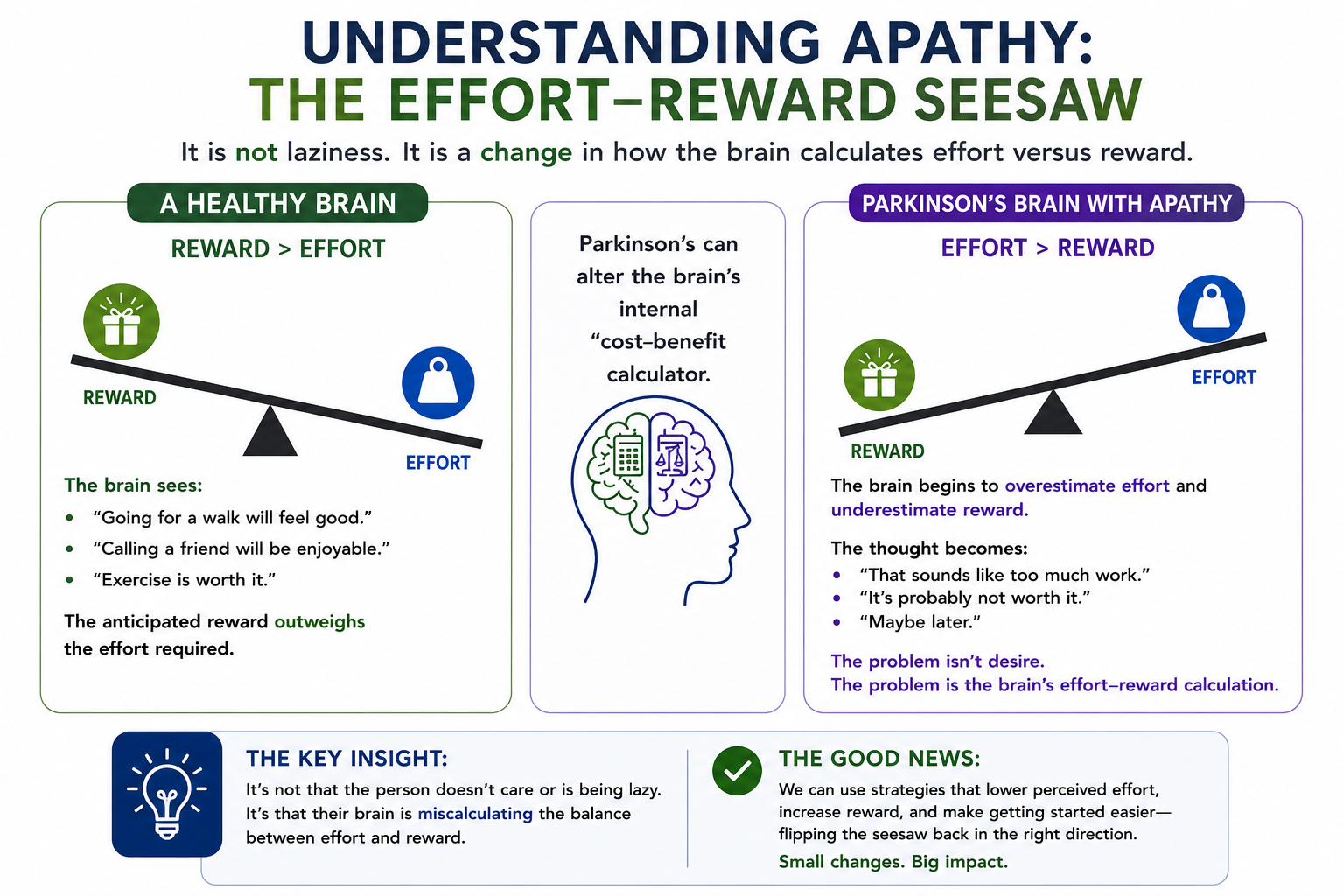
The internal dialogue becomes:
That sounds like a lot of work.
It's probably not worth it.
Maybe later.
Don't wanna.
What's fascinating is that many people with Parkinson's report feeling better after they exercise, attend a class, go for a walk, or meet up with friends. The activity itself wasn't the problem. The challenge was overcoming the brain's initial effort-reward calculation and getting started in the first place.
This understanding is important because it shifts our approach from trying to convince people to be motivated to creating systems that make action easier.
Using the COM-B Model to Outsmart Apathy
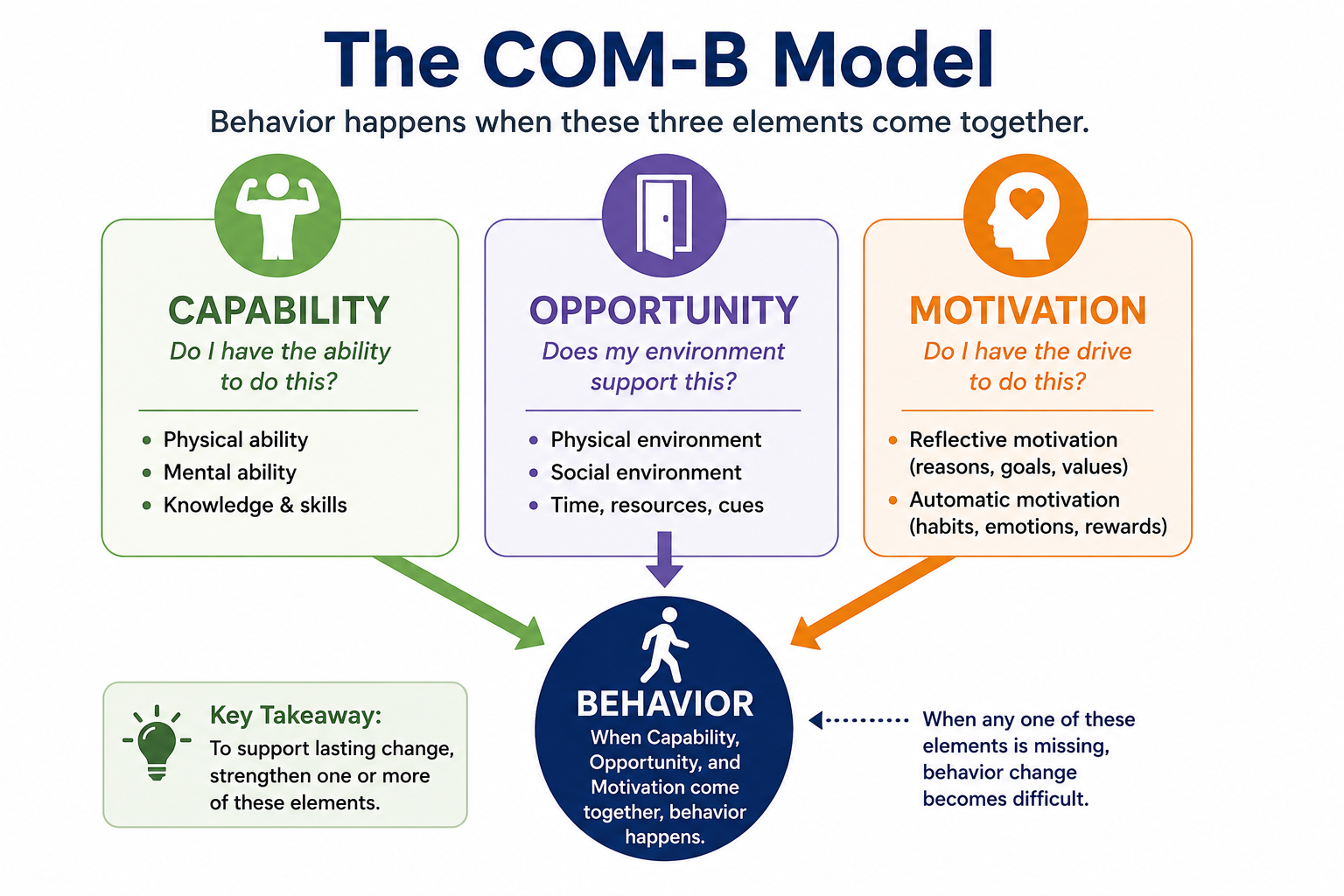
One of the most useful behavior-change frameworks discussed at the World Parkinson Congress was the COM-B Model. COM-B proposes that behavior occurs when three things come together:
Capability – Do I have the physical and cognitive ability to do this?
Opportunity – Does my environment support this behavior?
Motivation – Do I have enough drive, reward, habit, or reason to act?
When apathy is present, motivation is often the most obvious barrier, but it's rarely the only one. Sometimes the behavior is physically too difficult. Sometimes the environment creates unnecessary obstacles. Sometimes the reward feels too distant or too small to justify the effort.
The encouraging part is that we don't always have to increase motivation directly. In fact, trying to "motivate" someone with Parkinson's-related apathy is often the least effective approach. Instead, we can change the environment, simplify the task, build routines, leverage social support, and reconnect the activity to something meaningful. We can start to beat apathy at its own game! The following strategies are designed to do exactly that.
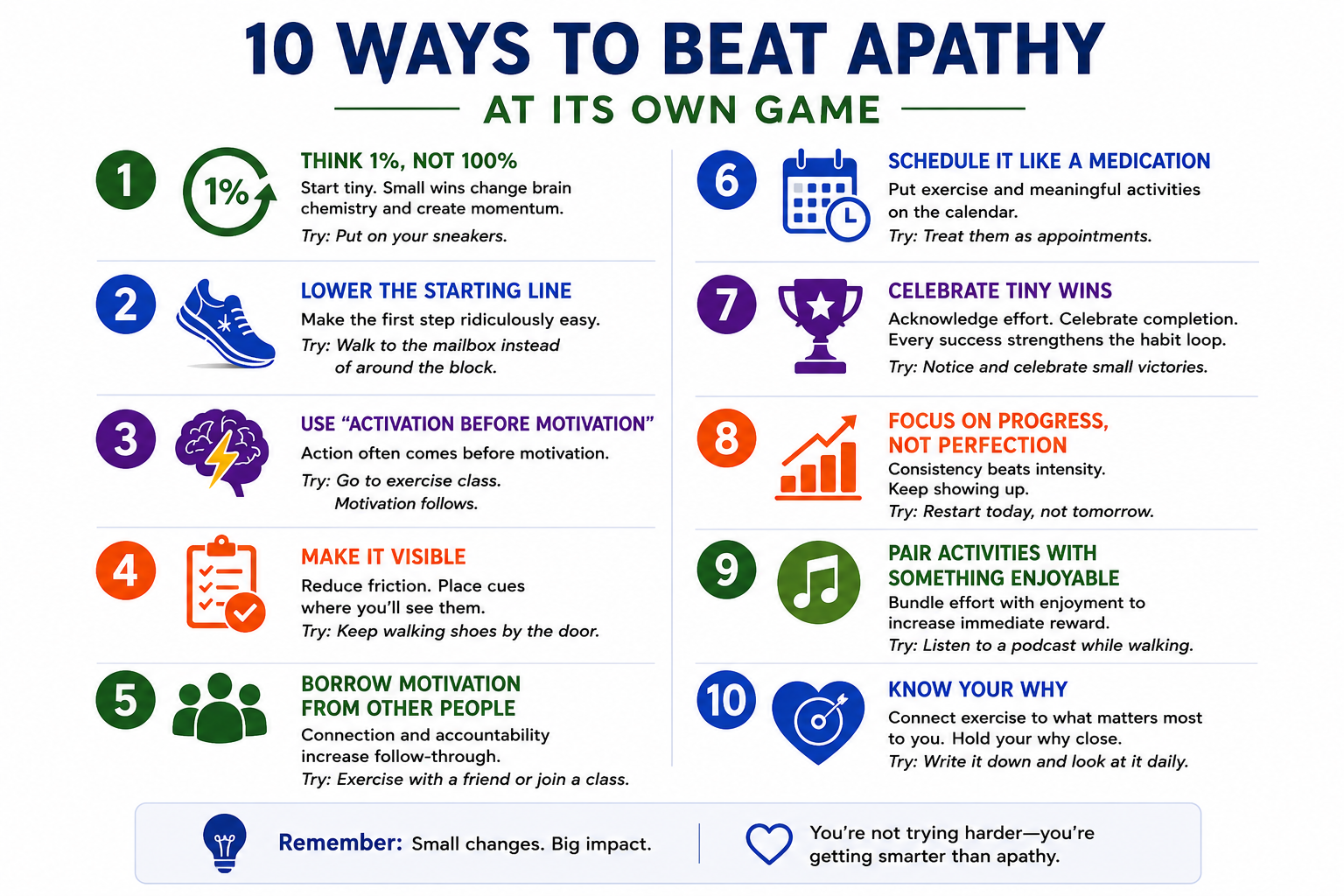
1. Think 1%, Not 100%
One of the most common mistakes people make is trying to change everything at once. Someone who hasn't exercised in months decides they're going to start walking 30 minutes every day. Someone who struggles with household tasks creates a long to-do list. Someone who wants to improve their health commits to changing their entire lifestyle overnight.
The Parkinson's brain often looks at those goals and immediately calculates the effort required. The result is predictable:
"Don't wanna."
Instead of focusing on the final destination, focus on the smallest possible first step. James Clear, author of Atomic Habits, calls this becoming "the type of person who shows up." The goal isn't to complete the workout. The goal is to begin.
For example, instead of committing to a 30-minute walk, commit to putting on your sneakers. Instead of promising yourself you'll complete your entire exercise program, commit to doing one exercise. Instead of attending an hour-long support group, commit to walking through the door. When I go running (which in case you're wondering my brain shouts loudly ‘Don’t wanna!!!), I give myself mini-goals - I’m not out there to run 3 miles, but I am going to run to the next driveway.
The beauty of small actions is that they dramatically reduce perceived effort while creating momentum. Often the hardest part isn't the activity itself—it's getting started.
COM-B Target: Opportunity and Motivation
2. Lower the Starting Line
Closely related to the 1% rule is the idea of lowering the starting line. We tend to believe success comes from raising expectations. In reality, success often comes from making the first step easier.
Many people with Parkinson's create goals that are so ambitious they become intimidating. The brain sees a mountain and decides it would rather stay on the couch.
Lowering the starting line means creating a version of success that feels almost impossible to fail.
If your goal is strength training, perhaps success today is one set of sit-to-stands.
If your goal is walking, perhaps success is walking to the mailbox.
If your goal is exercising three times this week, perhaps success is getting dressed in your exercise clothes and going to check out the local gym or observing a local PD fitness class.
The goal isn't to stay there forever. The goal is to create enough forward momentum that the next step becomes easier.
COM-B Target: Capability and Opportunity
3. Use Activation Before Motivation
Many people believe motivation comes first and action follows, but research suggests the opposite is often true. We wait to feel motivated before exercising. We wait to feel inspired before starting a project. We wait to feel energetic before going out with friends.
The problem is that motivation is unreliable.
Behavioral science consistently shows that action often creates motivation rather than the other way around. Once we begin moving, the brain receives new information. The activity may be enjoyable. We may feel accomplished. We may realize the task wasn't nearly as difficult as anticipated.
For someone with Parkinson's, this is a powerful concept because it shifts the goal from "feel motivated" to "take one action."
You don't have to want to go to exercise class.
You just have to get in the car.
COM-B Target: Motivation
4. Make It Visible
One of the easiest ways to improve follow-through is to redesign your environment.
The more effort required to remember a behavior, the less likely it is to happen. This becomes particularly important in Parkinson's disease, where cognitive load may already be increased. Think about your daily environment.
Do your walking shoes live in the back of a closet?
Are your exercise bands buried in a drawer?
Do you have to search for your water bottle every morning?
Every additional step increases friction.
Instead, place cues where you'll see them. Leave your walking shoes by the door. Keep exercise equipment near your favorite chair. Put your medication organizer somewhere visible. Use calendars, reminders, and visual prompts.
Successful habits often depend less on willpower and more on environment.
COM-B Target: Opportunity
5. Borrow Motivation From Other People
One of the strongest findings in Parkinson's exercise research is that people tend to do better when they're connected to others. Humans are social creatures and we are far more likely to show up when someone else is expecting us.
A walking partner creates accountability.
An exercise class creates routine.
A support group creates connection.
A personal trainer creates structure.
Social support also provides something equally important: encouragement during the inevitable periods when motivation is low. There will be days when you don't feel like exercising. There will be days when symptoms are frustrating. Having people around you who understand those challenges can make all the difference.
Sometimes we don't need more motivation.
Sometimes we just need good company.
COM-B Target: Opportunity and Motivation
6. Schedule It Like a Medication
Most people don't wake up each morning and ask themselves whether they feel motivated to take their medication - They simply do it.
Exercise and meaningful activities deserve the same level of commitment.
One of the most effective strategies for overcoming apathy is removing the decision altogether. Rather than deciding each day whether you'll exercise, decide once and put it on the calendar.
Monday at 10:00 AM.
Wednesday at 10:00 AM.
Friday at 10:00 AM.
Done.
Every decision requires energy. Every decision creates an opportunity for the Parkinson's brain to say "maybe later." Scheduling turns exercise from a choice into a routine.
COM-B Target: Opportunity
7. Celebrate Tiny Wins
The Parkinson's brain can become very good at focusing on what's missing.
"I only walked ten minutes."
"I didn't finish everything."
"I should have done more."
Unfortunately, this mindset reduces reward and reinforces apathy. Behavioral science teaches us that behaviors that get rewarded tend to get repeated. The reward doesn't need to be large. It simply needs to exist.
Did you exercise today? Celebrate it.
Did you attend your support group? Celebrate it.
Did you do one exercise instead of none? Celebrate it.
Your celebration can be a physical ‘air-five’ to yourself, a verbalized ‘You did great today! or a check-off on your tracking worksheet. Progress is progress and repeated acknowledgement of your success will help reset your reward vs. effort seesaw in the proper direction.
Tiny wins create momentum, confidence, and a stronger sense of self-efficacy.
COM-B Target: Motivation
8. Focus on Progress, Not Perfection
Perfectionism can be surprisingly damaging.
When people believe success means doing everything perfectly, they often choose not to start at all.
Missed one workout? The week feels ruined.
Missed a few days? The month feels ruined.
Behavior change doesn't work that way.
The people who succeed long-term aren't the people who never miss a day. They're the people who recover quickly when they do.
One missed workout doesn't matter.
One missed week doesn't matter.
What matters is returning.
Apathy loves all-or-nothing thinking. Progress thrives on flexibility. Instead of letting one missed opportunity derail the next, adopt a ‘next best decision’ mindset and take focus forward, not behind you.
COM-B Target: Motivation
9. Pair Activities With Something Enjoyable
Researchers sometimes call this "temptation bundling."
The idea is simple: combine something you need to do with something you enjoy doing to help increase the immediate reward associated with the activity.
Try listening to your favorite podcast while walking or saving your favorite television show for while you ride your riding the stationary bike.
Make a plan to meet a friend for coffee after exercise class.
The Parkinson's brain often discounts future rewards. Pairing an activity with something enjoyable helps bring some of that reward into the present moment.
COM-B Target: Motivation
10. Know Your Why
This may be the most important strategy of all.
People don't stay motivated because of exercise - they stay motivated because of what exercise allows them to do. If you ask most people why they exercise, most will answer something like ‘I know it’s good for me’ or ‘my doctor said to’ but that's not a why - that's an instruction.
A real why needs to be much more personal.
Maybe it's so you can keep attending your granddaughter's soccer games, or walk on the beach during your annual family vacation.
Maybe it's so you can keep traveling, gardening or playing pickleball with your friends
Maybe it's dancing at a wedding - or being able to walk your daughter down the aisle.
Maybe it's remaining independent and continuing to live in your own home.
THESE are reasons worth fighting for.
When symptoms are challenging and motivation is low, your why becomes an anchor. It reminds you that exercise isn't really about exercise. It's about protecting the life you want to continue living.
Write your why down.
Put it on the refrigerator.
Keep it in your wallet.
Talk about it with your family.
And when the Parkinson's brain says "don't wanna," remind yourself why you started in the first place.
Hold your why tight.
The Bottom Line
Apathy lies.
It tells you the effort is too great. It tells you it isn't worth it. It tells you you'll do it tomorrow, but the science tells a different story.
Most people feel better after they start.
Most people discover the activity wasn't nearly as difficult as their brain predicted.
And most people find that small actions, repeated consistently over time, can create remarkable changes in strength, mobility, confidence, independence, and quality of life.
The goal isn't to overpower apathy through sheer willpower. The goal is to understand how Parkinson's changes the brain's effort vs. reward calculation and then build systems that make action easier.
Start small.
Make it visible.
Use support.
Know your why.
And remember: sometimes beating apathy isn't about trying harder.
It's about outsmarting it and beating it at its own game. And PS: If your brain responded ‘don’t wanna’ after reading all 10 of these tips, it’s because 10 tips is too much right now. Follow the 1% rule and pick ONE TIP and start there. I promise it will help.

WPC 2026 Update: The Current State of the Science - Parkinson's Research is Changing Faster Than Most People Realize
One of the beautiful things about spending four days immersed in Parkinson's science is that you hear the same concepts repeated from different perspectives. Neurologists, neuroscientists, geneticists, rehabilitation specialists, and pharmaceutical researchers may all speak different scientific languages, but by the end of the week clear themes begin to emerge.
The biggest theme I heard over and over again was this:
Parkinson's research is rapidly moving toward earlier diagnosis, more accurate biological classification, and ultimately precision medicine.
One of the biggest things I took away from the World Parkinson Congress wasn't a single study, a new medication, or a groundbreaking announcement.
It was finally understanding how all the pieces of Parkinson's research are starting to connect together.
One of the beautiful things about spending four days immersed in Parkinson's science is that you hear the same concepts repeated from different perspectives. Neurologists, neuroscientists, geneticists, rehabilitation specialists, and pharmaceutical researchers may all speak different scientific languages, but by the end of the week clear themes begin to emerge.
The biggest theme I heard over and over again was this:
Parkinson's research is rapidly moving toward earlier diagnosis, more accurate biological classification, and ultimately precision medicine.
For decades, Parkinson's disease was largely viewed as a dopamine disorder. And while the loss of dopamine-producing neurons remains central to the disease, researchers now recognize that Parkinson's is far more biologically complex than we once thought.
Across lecture after lecture, four major biological processes repeatedly emerged as key players in Parkinson's disease:
• Loss of dopamine-producing neurons
• Alpha-synuclein aggregation (Lewy body formation)
• Mitochondrial dysfunction
• Neuroinflammation
These processes do not occur independently. They interact with one another in ways we are only beginning to understand.
Even more importantly, researchers increasingly believe these biological changes may begin years—perhaps even decades—before the first tremor, shuffling gait, or diagnosis.
Many experts now estimate that a person may lose 50% or more of their dopamine-producing neurons before classic motor symptoms become noticeable. If true, Parkinson's disease may already be well underway 10–20 years before diagnosis.
This realization is changing everything.
The goal is no longer simply diagnosing Parkinson's disease after symptoms appear. The goal is identifying it earlier, understanding which biological pathways are driving disease in each individual, and eventually matching people with therapies designed for their specific disease subtype.
In other words, the future of Parkinson's care may not be one treatment for everyone. It may be the right treatment for the right person at the right stage of disease.
And that future may be closer than many people realize.
What's Next in This Series
This article is the first in a series exploring the major themes that emerged from the World Parkinson Congress and the rapidly evolving landscape of Parkinson's research.
Below, I'll take a deeper dive into some of the most important topics shaping the future of diagnosis, treatment, and ultimately disease modification. You can click each link to read the next section.
Part 2: Why Everyone Is Talking About Alpha-Synuclein
What alpha-synuclein is, why it matters, how it may spread through the nervous system, and why researchers believe it could hold the key to earlier diagnosis and new treatments.
Part 3: Is Parkinson's Genetic?
A look at the genes most strongly linked to Parkinson's disease—including LRRK2, GBA1, PINK1, and Parkin—and how genetics is driving a new era of targeted therapies.
Part 4: The New Way We Classify Parkinson's Disease
Why researchers are moving beyond symptom-based diagnosis toward biological staging systems, disease subtypes, and precision medicine.
Part 5: The Race Toward Disease-Modifying Therapies
An overview of the most promising approaches currently being tested, including alpha-synuclein therapies, LRRK2 inhibitors, anti-inflammatory treatments, mitochondrial therapies, and innovative platform trials.
Part 6: Are We Getting Closer to a Cure?
Exploring stem cells, regenerative medicine, cell replacement therapies, and the realistic possibilities—and limitations—of future curative treatments.
In Summary
The more I listened to researchers, clinicians, and people living with Parkinson's throughout the Congress, the more one thing became clear: we are entering a new chapter in Parkinson's research.
Many questions remain unanswered, and progress is rarely as fast as any of us would like. But for the first time, researchers have the tools to identify biological changes earlier, classify disease more precisely, and test therapies designed to target the underlying mechanisms of Parkinson's itself.
That's a very different place than we were even a decade ago.
And it's why there is more reason for cautious optimism today than at any point to date in the journey to better understand this complex disease.