
If you've ever wondered what an occupational therapist actually does, you're not alone.
At Healthy Aging Physical Therapy, we're incredibly fortunate to have an amazing team of Occupational Therapists who help our patients stay safe, independent, and engaged in the activities that matter most. Yet despite the tremendous value OT provides, it's also one of the most misunderstood healthcare professions.
When we recommend Occupational Therapy to a patient or caregiver, we often hear responses like:
"I don't need OT—I can dress myself."
"My husband helps me with those things."
"I already had OT when I was in the hospital."
These are all common misconceptions, and they're understandable. For many people, their only experience with Occupational Therapy has been during a short hospital stay or inpatient rehabilitation, where the focus is often on helping someone become safe enough to return home.
But Occupational Therapy can offer so much more.
This month, we wanted to take some time to highlight the many ways Occupational Therapists help older adults remain independent, improve safety, simplify everyday tasks, and continue doing the activities that bring meaning to their lives.
So What DOES an Occupational Therapist Do?
Occupational Therapists evaluate how health conditions affect your ability to perform everyday activities, including:
Getting dressed
Bathing safely
Preparing meals
Managing medications
Getting on and off the toilet or in and out of bed
Using your hands for cooking, writing, or hobbies
Remembering daily routines
Safely moving around your home
Conserving energy throughout the day
Rather than simply treating a diagnosis, Occupational Therapists look at the whole picture:
Your home
Your daily routines
Your goals
Your caregivers
The obstacles preventing you from living as independently as possible
The goal of Occupational Therapy isn't simply to identify challenges—or even just to prescribe exercises.
It's about understanding how physical, cognitive, sensory, or environmental factors are affecting your daily life and then creating an individualized plan to address them. Sometimes that means rehabilitating a skill through targeted treatment to improve strength, coordination, cognition, or function. Other times, it means compensating with adaptive strategies, environmental modifications, or assistive equipment that allows you to safely and confidently accomplish the task in a different way.
These approaches are often intertwined. An Occupational Therapist may work to improve your abilities while simultaneously teaching strategies that help you remain successful during the recovery process—or when certain changes can't be completely reversed.
Ultimately, the goal is to maximize your independence, safety, confidence, and quality of life so you can continue participating in the everyday activities that matter most to you—not just today, but for years to come.
Who Can Benefit from Occupational Therapy?
Occupational Therapy is appropriate for many older adults, including those living with:
Parkinson's disease
Stroke
Arthritis
Joint replacements
Neurological conditions
Multiple sclerosis
Hand injuries
Memory changes or early dementia
General weakness after hospitalization
Frequent falls or fear of falling
Many people assume they need to wait until they're "disabled" before seeing an OT.
In reality, Occupational Therapy is often most effective when challenges are identified and addressed early—before they become major barriers to independence. Small changes in strength, balance, hand function, memory, vision, endurance, or confidence can gradually make everyday tasks more difficult. Left unaddressed, these small challenges can snowball into falls, injuries, loss of independence, or increased reliance on family members and caregivers.
Why Outpatient Occupational Therapy in Your Home Is So Effective
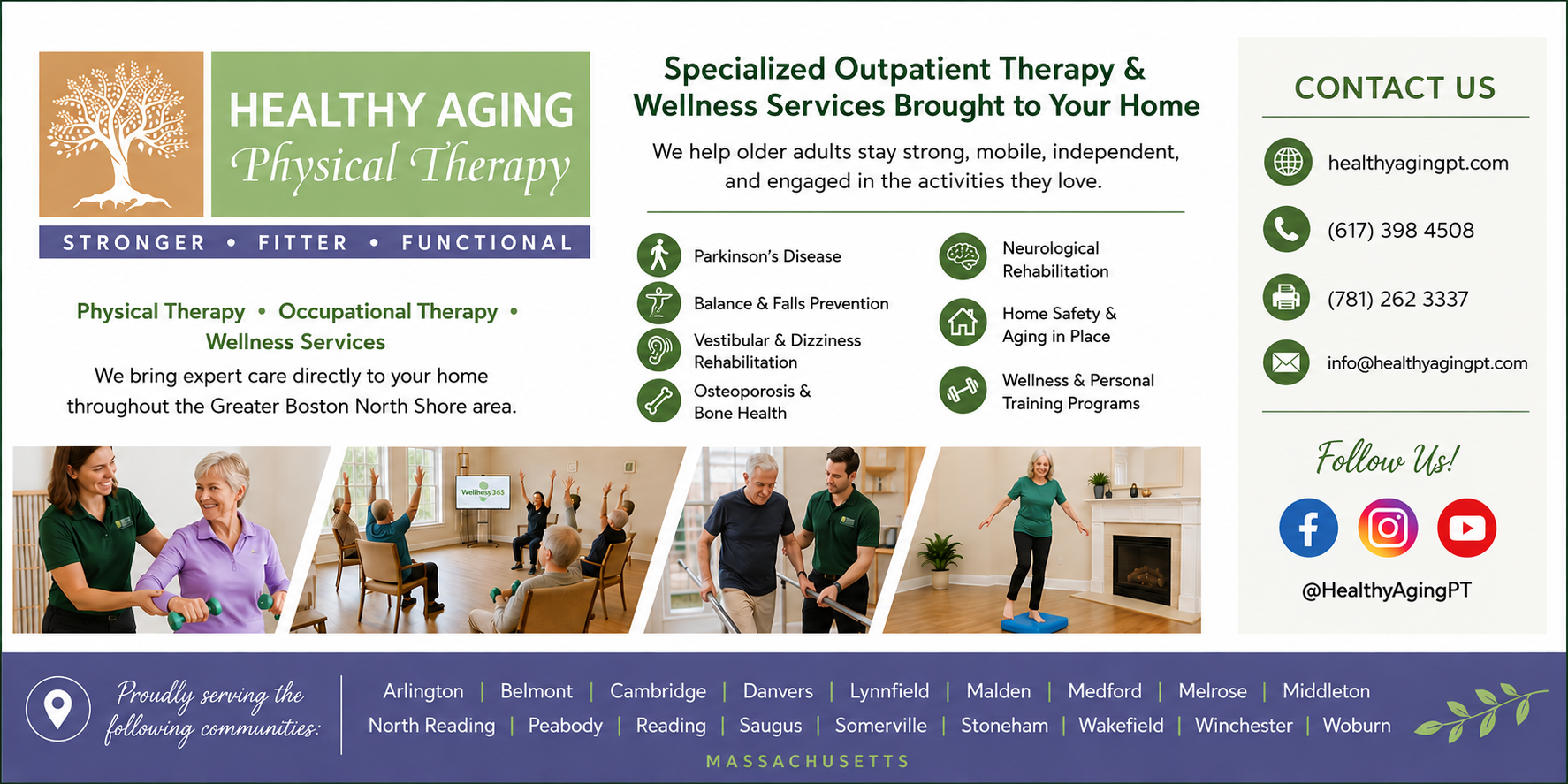
At Healthy Aging Physical Therapy, we provide outpatient Occupational Therapy in the comfort of your home. That means you receive the same high-quality, one-on-one therapy you would expect from an outpatient clinic, but in the environment where you spend your everyday life.
While avoiding traffic, parking, and waiting rooms is certainly a bonus, the greatest benefit is that therapy becomes immediately practical, personalized, and meaningful.
We Treat You Where Life Actually Happens
The challenges you experience don't happen in a therapy gym—they happen in your bathroom, your kitchen, your bedroom, your front entryway, and while completing the routines that make up your day.
By working in your own home, your Occupational Therapist can see firsthand what's making daily activities difficult. Rather than guessing or relying on descriptions, we can evaluate your actual environment and develop solutions that fit your home, your routines, and your goals.
Therapy Is Functional from Day One
Instead of practicing simulated tasks in a clinic, we practice the activities you actually want and need to do.
That might include:
Safely getting in and out of your own shower
Preparing meals in your own kitchen
Organizing medications where you normally keep them
Learning strategies for navigating your own stairs
Reaching items in your own cabinets
Safely completing laundry or household tasks
Because therapy is directly connected to your daily routine, the skills you learn are immediately applicable and easier to carry over into everyday life.
We Can Identify Problems Before They Become Bigger Ones
Many safety concerns aren't obvious until someone observes you moving around your own home.
Your Occupational Therapist can identify fall hazards, recommend simple environmental modifications, suggest adaptive equipment when appropriate, and teach strategies that make everyday activities safer and more efficient—all while preserving your independence.
Often, small changes can make a tremendous difference in confidence, safety, and quality of life.
We Partner with your Caregivers
When family members or caregivers are involved, home-based Occupational Therapy allows us to provide education and hands-on training in the environment where care is actually being provided.
Whether it's learning safer transfer techniques, simplifying daily routines, or creating strategies for someone living with Parkinson's disease, dementia, or another neurological condition, we can coach caregivers in real time using the home's actual layout and daily routines.
The Goal Is Independence at Home
Ultimately, our mission is simple: to help you continue living safely, confidently, and independently in the place you call home.
By combining evidence-based outpatient therapy with the real-world advantages of treating you in your own environment, we can develop solutions that are practical, personalized, and designed to support your independence for years to come.
Can an Occupational Therapist Recommend the Best Adaptive Equipment for Me?
Yes! Occupational Therapists are experts in identifying adaptive equipment and assistive devices that can make everyday activities safer, easier, and more independent. Whether it's recommending the right shower chair, grab bars, raised toilet seat, reacher, dressing aids, kitchen tools, or mobility accessories, your Occupational Therapist can help you determine what equipment is appropriate—and just as importantly, teach you how to use it correctly.
But choosing equipment is only one part of the evaluation.
Before recommending a solution, an Occupational Therapist first asks why a task has become difficult.
Is it because of weakness? Poor balance? Decreased coordination? Pain? Fatigue? Vision changes? Memory concerns? Or is the environment itself making the task more challenging?
Understanding the underlying cause allows us to recommend the most effective approach.
Sometimes that means rehabilitating the problem through strengthening, coordination training, cognitive rehabilitation, or practicing functional activities. Other times, it means teaching new techniques, modifying the environment, or introducing adaptive equipment that allows you to complete the task more safely and efficiently.
More often than not, it's a combination of both.
Our goal isn't simply to recommend equipment—it's to help you find the right combination of rehabilitation, education, environmental modifications, and adaptive tools to maximize your independence, safety, and quality of life.
Is Occupational Therapy Only for People Recovering from Surgery?
Not at all.
Although Occupational Therapy is commonly provided after surgery or a hospitalization, many people benefit from OT long before—or long after—those events.
You might be a good candidate if everyday tasks are becoming more difficult than they used to be.
Maybe you're taking longer to get dressed. Perhaps you're avoiding cooking because standing is exhausting. Maybe opening jars has become frustrating, getting in and out of the shower feels less secure, or you're noticing changes in memory that are affecting your daily routine.
These small changes are often early signs that your body or brain is working harder to complete everyday tasks.
Occupational Therapy helps identify those challenges, address the underlying causes whenever possible, and develop practical strategies so you can continue living safely and independently.
You don't have to wait until something major happens to benefit from Occupational Therapy.
The Bottom Line
Whether that's cooking a favorite family recipe, gardening, safely caring for your spouse, getting dressed independently, or simply feeling confident walking through your own home, Occupational Therapy focuses on helping you live life as fully and independently as possible.
At Healthy Aging Physical Therapy, we believe the best place to learn how to live safely at home is...your home.
If you or someone you love is finding everyday activities more difficult than they used to be, Occupational Therapy may be exactly the support you've been looking for.