Healthy Aging Physical Therapy Monthly Blog
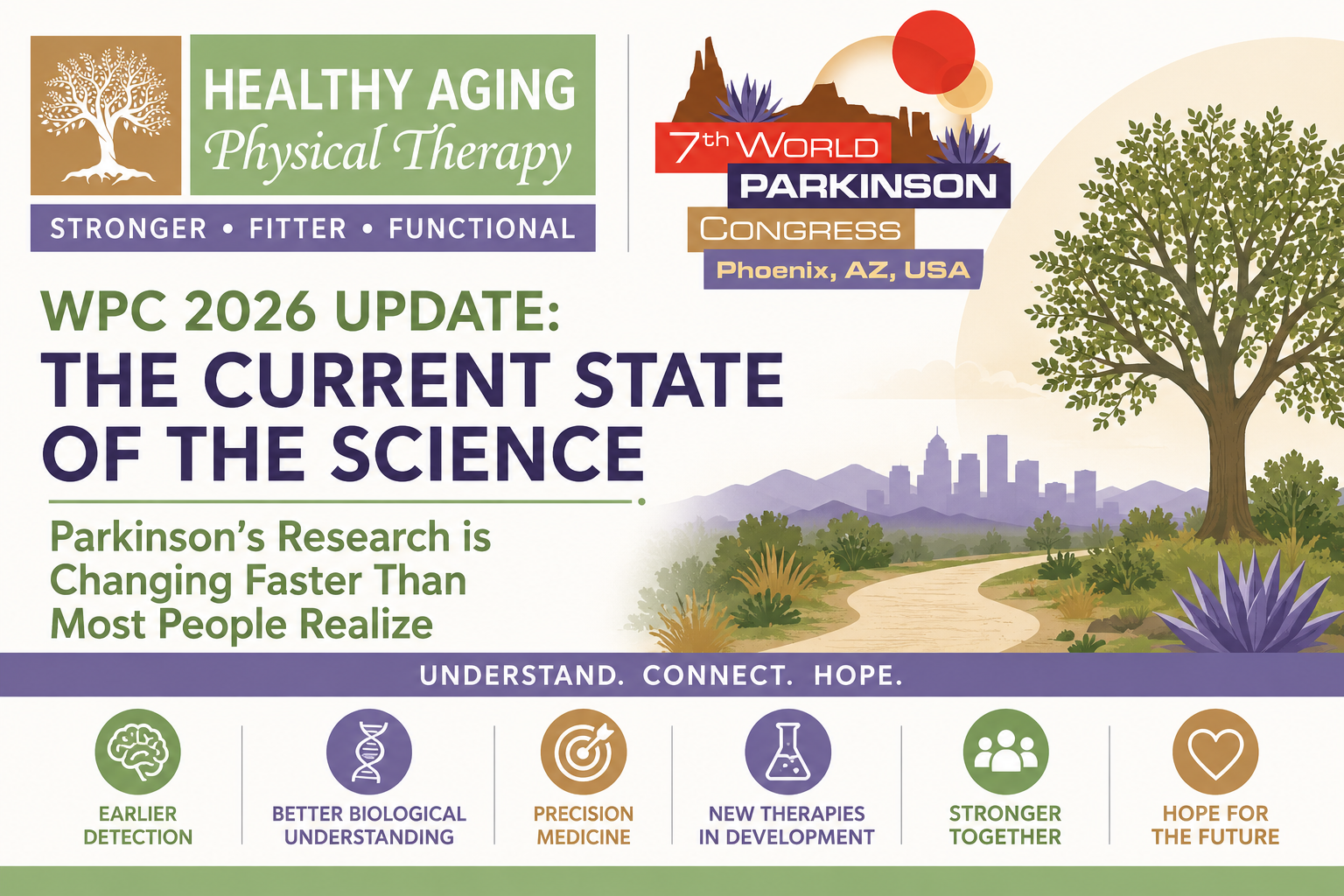
WPC 2026 Update: The Current State of the Science - Parkinson's Research is Changing Faster Than Most People Realize
One of the beautiful things about spending four days immersed in Parkinson's science is that you hear the same concepts repeated from different perspectives. Neurologists, neuroscientists, geneticists, rehabilitation specialists, and pharmaceutical researchers may all speak different scientific languages, but by the end of the week clear themes begin to emerge.
The biggest theme I heard over and over again was this:
Parkinson's research is rapidly moving toward earlier diagnosis, more accurate biological classification, and ultimately precision medicine.
One of the biggest things I took away from the World Parkinson Congress wasn't a single study, a new medication, or a groundbreaking announcement.
It was finally understanding how all the pieces of Parkinson's research are starting to connect together.
One of the beautiful things about spending four days immersed in Parkinson's science is that you hear the same concepts repeated from different perspectives. Neurologists, neuroscientists, geneticists, rehabilitation specialists, and pharmaceutical researchers may all speak different scientific languages, but by the end of the week clear themes begin to emerge.
The biggest theme I heard over and over again was this:
Parkinson's research is rapidly moving toward earlier diagnosis, more accurate biological classification, and ultimately precision medicine.
For decades, Parkinson's disease was largely viewed as a dopamine disorder. And while the loss of dopamine-producing neurons remains central to the disease, researchers now recognize that Parkinson's is far more biologically complex than we once thought.
Across lecture after lecture, four major biological processes repeatedly emerged as key players in Parkinson's disease:
• Loss of dopamine-producing neurons
• Alpha-synuclein aggregation (Lewy body formation)
• Mitochondrial dysfunction
• Neuroinflammation
These processes do not occur independently. They interact with one another in ways we are only beginning to understand.
Even more importantly, researchers increasingly believe these biological changes may begin years—perhaps even decades—before the first tremor, shuffling gait, or diagnosis.
Many experts now estimate that a person may lose 50% or more of their dopamine-producing neurons before classic motor symptoms become noticeable. If true, Parkinson's disease may already be well underway 10–20 years before diagnosis.
This realization is changing everything.
The goal is no longer simply diagnosing Parkinson's disease after symptoms appear. The goal is identifying it earlier, understanding which biological pathways are driving disease in each individual, and eventually matching people with therapies designed for their specific disease subtype.
In other words, the future of Parkinson's care may not be one treatment for everyone. It may be the right treatment for the right person at the right stage of disease.
And that future may be closer than many people realize.
What's Next in This Series
This article is the first in a series exploring the major themes that emerged from the World Parkinson Congress and the rapidly evolving landscape of Parkinson's research.
Below, I'll take a deeper dive into some of the most important topics shaping the future of diagnosis, treatment, and ultimately disease modification. You can click each link to read the next section.
Part 2: Why Everyone Is Talking About Alpha-Synuclein
What alpha-synuclein is, why it matters, how it may spread through the nervous system, and why researchers believe it could hold the key to earlier diagnosis and new treatments.
Part 3: Is Parkinson's Genetic?
A look at the genes most strongly linked to Parkinson's disease—including LRRK2, GBA1, PINK1, and Parkin—and how genetics is driving a new era of targeted therapies.
Part 4: The New Way We Classify Parkinson's Disease
Why researchers are moving beyond symptom-based diagnosis toward biological staging systems, disease subtypes, and precision medicine.
Part 5: The Race Toward Disease-Modifying Therapies
An overview of the most promising approaches currently being tested, including alpha-synuclein therapies, LRRK2 inhibitors, anti-inflammatory treatments, mitochondrial therapies, and innovative platform trials.
Part 6: Are We Getting Closer to a Cure?
Exploring stem cells, regenerative medicine, cell replacement therapies, and the realistic possibilities—and limitations—of future curative treatments.
In Summary
The more I listened to researchers, clinicians, and people living with Parkinson's throughout the Congress, the more one thing became clear: we are entering a new chapter in Parkinson's research.
Many questions remain unanswered, and progress is rarely as fast as any of us would like. But for the first time, researchers have the tools to identify biological changes earlier, classify disease more precisely, and test therapies designed to target the underlying mechanisms of Parkinson's itself.
That's a very different place than we were even a decade ago.
And it's why there is more reason for cautious optimism today than at any point to date in the journey to better understand this complex disease.