Written by: Dr. Katie Wadland, PT, DPT, Board-Certified Geriatric Clinical Specialist and owner of Healthy Aging Physical Therapy
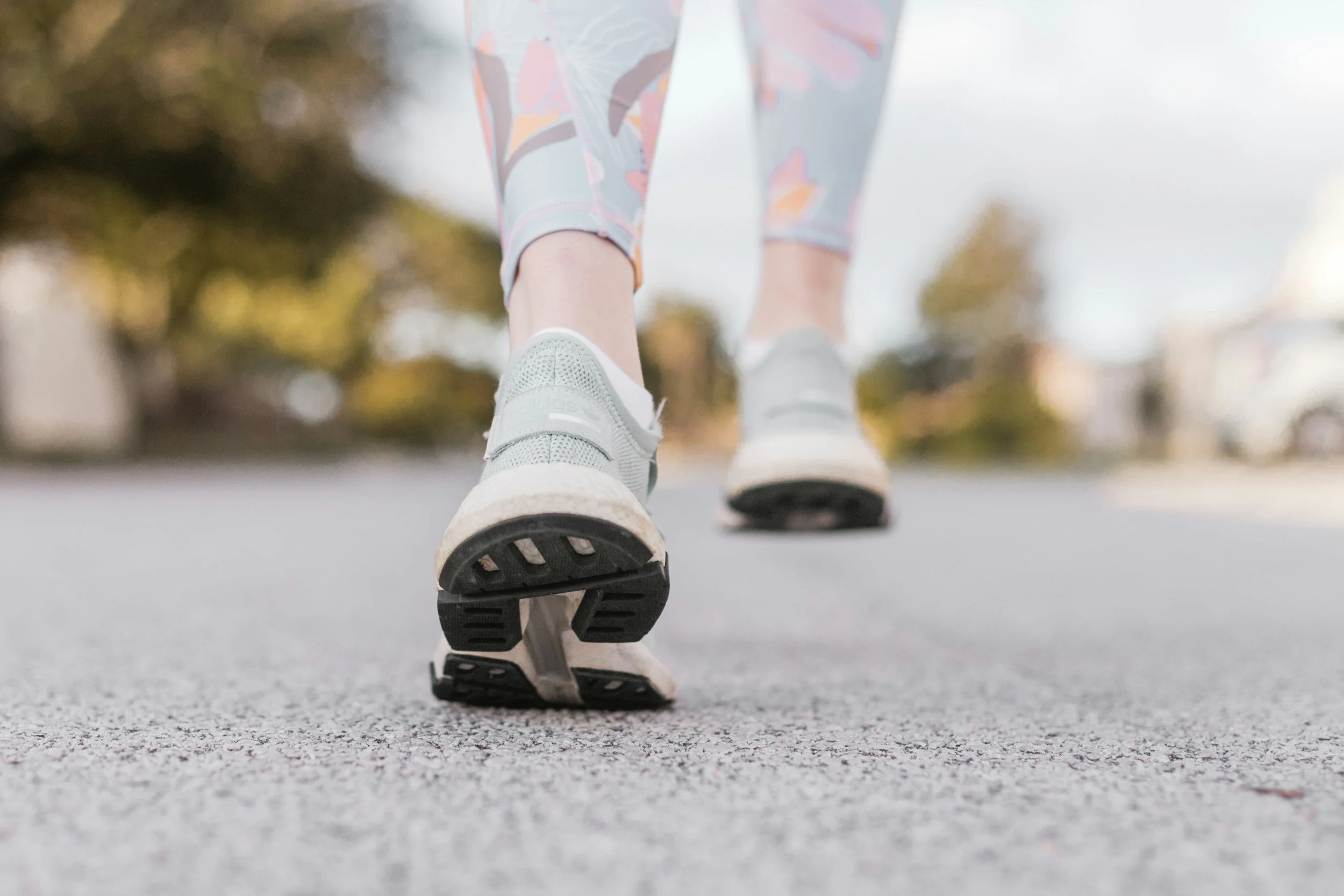
Last month, we introduced OneStep, the walking and movement app we now use at Healthy Aging Physical Therapy to better understand how our patients move in the real world - at home, in the community and both with and without their therapists.
While we’ve been loving the experience of using OneStep so far — and many of you have enjoyed seeing your progress in real time — we’ve also received some great feedback: “What do all these numbers actually mean?”
So this month, we’re diving deeper. This blog — along with our social media posts throughout March — will focus on breaking down exactly what we’re measuring, what the data tells us, and why it matters for your safety, strength, and independence.
Let’s break down what we’re measuring—and why it’s so powerful.
Walking Is More Than Just Speed
Most people assume walking is simply about how fast you move from point A to point B. In reality, walking is a complex, whole-body activity that reflects strength, balance, coordination, confidence, and even cognitive load.
Using OneStep, we’re able to measure multiple aspects of your walking pattern over time, giving us a clearer picture of both current safety and future risk.
The Big Picture: Your Walk Score
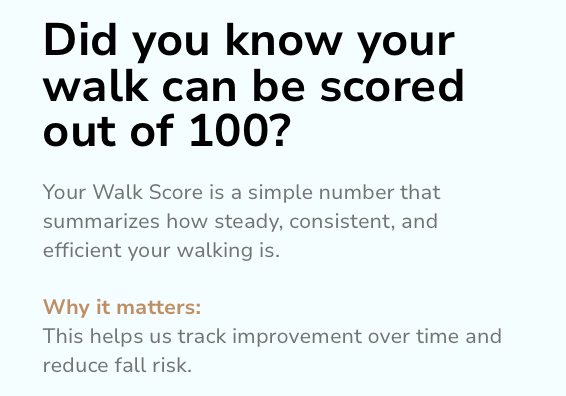
One of the first things you may notice in OneStep is your Walk Score.
This is a single number (out of 100) that summarizes how:
Steady your steps are
Consistent your rhythm is
Smoothly you move from step to step
A higher Walk Score reflects a safer, more efficient walking pattern. While we never rely on one number alone, this score helps us track meaningful changes over time and identify when something may need attention.
Understanding other Key Walking Parameters
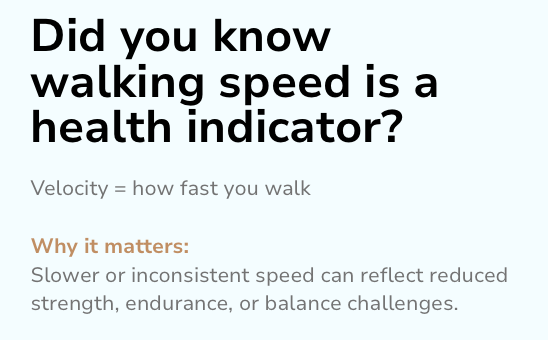
Walking Speed (Velocity)
Walking speed is measured in meters per second and is one of the strongest indicators of functional mobility.
Slower speeds may reflect weakness, balance challenges, or reduced endurance
Inconsistent speed may signal fatigue, distraction, or instability
While 1.0–1.2 m/sec is typical for healthy adults, many of our patients do very well with a goal closer to 0.8 m/sec, which is strongly correlated with safe household mobility and independence.
Cadence (Steps per Minute)
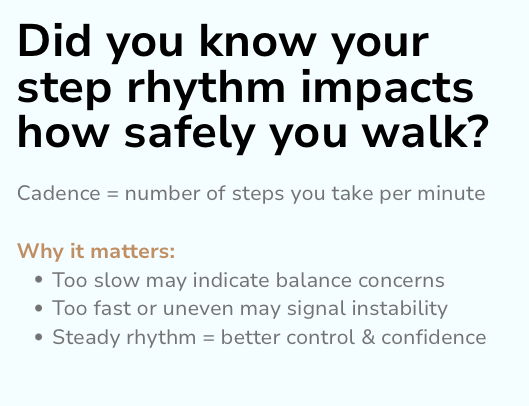
Cadence is how many steps you take per minute while walking.
Very slow cadence can be linked to balance concerns, reduced confidence, or cautious movement
Very fast or uneven cadence can indicate rushing or difficulty controlling speed
For many adults, a steady cadence between 100–120 steps per minute is associated with comfortable, efficient walking. In Parkinson’s Disease, we often see cadence increase which is reflective of a ‘shuffled’ or ‘freezing’ gait - and something we are quickly finding can be significantly improved with this type of in-the-moment feedback.
Velocity Variability
This measures how consistent your walking speed is from step to step.
Low variability = steady, predictable walking
High variability = frequent changes in speed, often linked to balance challenges, fatigue, or environmental demands
Our general goal is less than 20% variability, reflecting controlled and confident movement.
Consistency
Consistency looks at how similar each step is to the next and is scored from 0–100.
Scores between 80–100 suggest a stable, repeatable walking pattern
Lower scores may reflect coordination changes, balance challenges, or neurologic conditions
This is an especially valuable number to monitor for patients with Parkinson’s disease, neurologic diagnoses, or anyone at risk for falls.
Looking Deeper: Step Symmetry, Timing, and Joint Motion
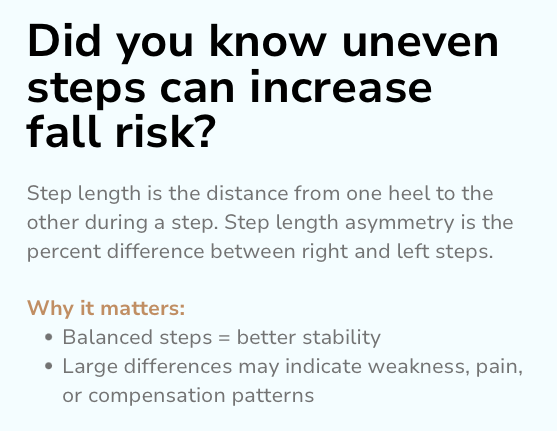
Beyond the general measures above, OneStep allows us to analyze more detailed gait data about spatial and temporal parameters, and joint range of motion, including:
Average step length
Step length asymmetry
Single-leg and double-leg support time
Stance symmetry
Step width
Hip and femoral range of motion during walking
These details help us identify why your walking may feel uneven, where balance is breaking down, and how strength, coordination, or joint immobility may be contributing - and this level of insight allows us to be more precise, and more effective, in your treatment.
Daily Step Count: Measuring Movement to Get You Moving More
Finally, OneStep also tracks your daily step count by connecting to your phone’s internal pedometer (and can sync with devices like Apple Watch or Fitbit).
Why this matters:
More daily steps are associated with better balance, strength, endurance, and overall health
Even small increases in daily walking can lead to meaningful improvements
For the most accurate data, we recommend carrying your phone in your pocket during as many walks as possible. Together, we’ll determine a personalized, safe daily step goal that you can work up to slowly, to promote optimal health and wellness as you age or live with chronic disease or disability.
Why This Matters at Healthy Aging Physical Therapy
At Healthy Aging Physical Therapy, our goal is not just to help you walk more, but to help you walk better, safer, and with more confidence.
By combining expert clinical care with real-world movement data, OneStep helps us:
Detect subtle changes earlier
Personalize care more precisely
Track progress that truly matters
Support long-term independence and fall prevention
We hope this blog post helps you better understand what you’re seeing in your OneStep data and feel more confident about how we’re using it to guide your care. This is what modern, whole-person physical therapy looks like - and we’re excited to take this journey with you.

