World Parkinson’s Congress 2026: Bringing it Home
Written by: Dr. Katie Wadland, PT, DPT, Board-Certified Geriatric Clinical Specialist and Owner of Healthy Aging Physical Therapy
This summer, I’m excited to share a three-part blog series inspired by my experience attending the 7th Annual World Parkinson’s Congress. Over four days surrounded by researchers, clinicians, people living with Parkinson’s, care partners, advocates, and innovators from around the world, I filled pages and pages with notes, ideas, questions, and moments that challenged the way I think about Parkinson’s disease, rehabilitation, exercise, behavior change, and what it truly means to help people live well.
One of the most powerful parts of the conference was realizing how rapidly our understanding of Parkinson’s continues to evolve. The themes repeated throughout the week were impossible to ignore: Parkinson’s is far more complex than simply a ‘dopamine disorder’, exercise remains one of the most powerful disease-modifying tools we currently have, and long-term success depends just as much on behavior, motivation, environment, and support as it does on medications or treatment techniques.
Rather than trying to summarize an entire conference in one overwhelming post, I wanted to slow down, digest the information, and share it in a way that feels meaningful and practical — both for people living with Parkinson’s and for the clinicians and care partners supporting them.
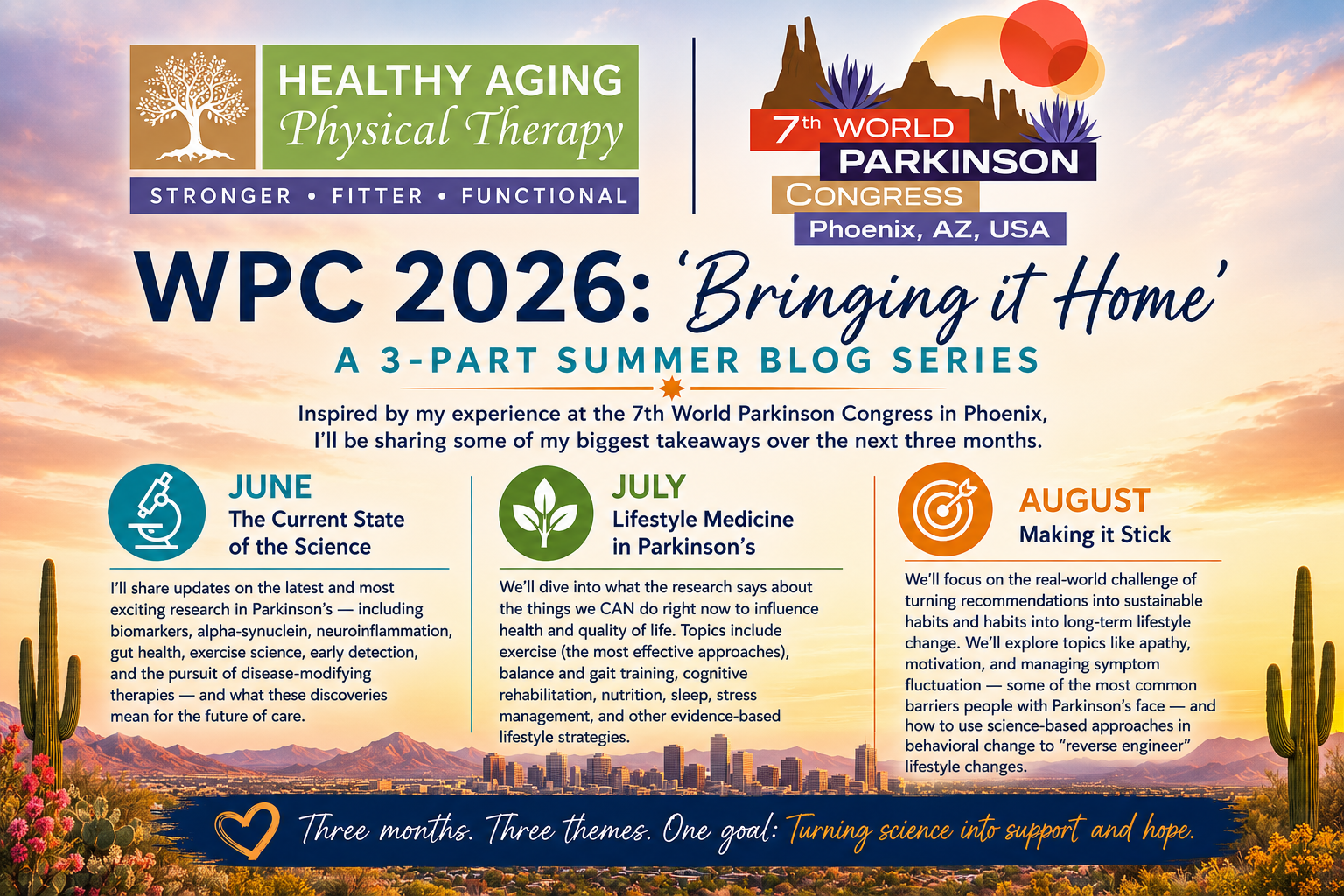
Over the next three months, I’ll be sharing some of my biggest takeaways from the conference:
In June, I’ll be sharing updates on The Current State of the Science of Parkinson’s — breaking down some of the most exciting and rapidly evolving research presented at the conference. We’ll explore topics like biomarkers, alpha-synuclein, neuroinflammation, gut health, exercise science, early detection, and the growing pursuit of disease-modifying treatments — along with what these discoveries may mean for the future of Parkinson’s care.
In July, we’ll shift into Lifestyle Medicine in Parkinson’s — diving into what the evidence says about the things we CAN do right now to influence health, function, and quality of life. I’ll be exploring the research behind exercise, balance and gait training, cognitive rehabilitation, nutrition, sleep, stress management, and other lifestyle strategies that are increasingly recognized as essential components of Parkinson’s management.
And finally, in August, we’ll focus on Making it Stick — the real-world challenge of turning recommendations into sustainable habits and habits into long-term lifestyle change. We’ll explore topics like apathy, motivation, and managing symptom fluctuation — some of the most common barriers people with Parkinson’s face when trying to consistently implement the things we know are helpful — and how science-based approaches to behavior change can help us “reverse engineer” lifestyle changes by creating systems, routines, environments, and supports that make healthy choices more realistic, sustainable, and achievable in everyday life.
My goal with this series is not just to “report back” from a conference, but to help translate complex science into real-world understanding and practical takeaways that can improve care, conversations, and quality of life.
I learned so much at WPC — and now I’m excited to bring it home to you.