Healthy Aging Physical Therapy Monthly Blog

How to Reduce Your Chance of Dying from Covid-19
Two recent studies came out that I think every Adult over 50 should know about. Read on for a brief review of these two journal articles + 5 simple strategies to improve your daily physical activity level to REDUCE your chance of death and disability from Covid-19.
Two recent studies came out that I think every Adult over 50 should know about. Read on for a brief review of these two journal articles + 5 Simple Ways to INCREASE your physical activity level to REDUCE your chance of death and disability from Covid-19.

First off, a September 2022 American Journal of Physical Medicine and Rehab (Physical Activity and Physical Activity Participation Barriers Among Adults 50 Years and Older During the COVID-19 Pandemic - PubMed (nih.gov)) looked at the impact the Covid-19 pandemic has had on exercise and physical activity levels in Adults over 50 years old in the United States. Now let me preface this with the fact that even prior to 2020, 60-80% of Older Adults were ALREADY not meeting the recommended levels of weekly physical activity that have been established to achieve improved health outcomes. (To remind you, this includes at least 150-300 Minutes per week of Moderately to Vigorously Intense Physical Activity + 2-3 Days per Week of Strength Training.) This study found that since the pandemic began, 43% of adults over 50 surveyed in this population report a FURTHER REDUCTION in their overall physical activity. Not surprisingly, common barriers cited included anxiety, difficulty accessing places to workout and difficulty committing to exercise. Further, individuals with heart or lung disease or a history of falling had further odds of reduced physical activity (and these are the folks that arguably need it the most!)
Secondly, and here's where this gets even more mind-blowing, the CDC released a systematic review of 25 studies that examined the impact of physical activity and Covid-19 outcomes (Brief Summary of Findings on the Association Between Physical Inactivity and Severe COVID-19 Outcomes (cdc.gov)). Not surprisingly, the data OVERWHELMINGLY indicates that reduced physical activity is associated with increased risk of hospitalization and death from Covid-19. Given the association between reduced activity and cardiovascular disease, obesity and diabetes, and the link between these diseases and worse outcomes in Covid-19, this, of course, makes total sense.
So, as we enter the FOURTH year of this never-ending pandemic, it is GLARINGLY CLEAR (to me, at least), that it is even MORE IMPORTANT, to help people find a way to make exercise a part of their everyday lives, ESPECIALLY when they have barriers to access and/or physical impairments or health conditions that impact their ability to do so. Healthy Aging Physical Therapy can be your partner in health and wellness and can help you INCREASE your Exercise and Physical Activity. If you find yourself limited by pain, fear, falls or physical limitations, we WANT to help you find ways to move better and move more. Whether you join us for a group class or prefer 1:1 Therapy or Wellness, give us a call, text or email and we'll find a way to help.
In the meantime, here are 5 Simple Ways to Improve your Daily Activity to REDUCE your risk of hospitalization and death from Covid-19:

1) Increase your Daily Step Count.
It doesn’t matter if you take 10 steps a day or 10,000, adding to your daily step count is a simple and effective way to increase your overall physical activity. If you spend most of your time at home, try to add an extra lap around your house each time you walk to the bathroom. If you go out and about each day, park a little further from your destination or walk an extra lap or two around the store. If you’re already pretty active, try using a step counter or Apple watch and increase your Step Goal by 500-1000 steps each month for some extra motivation.

2) Build in some Exercise Snacks.
‘Exercise Snacks’ are just what they sound like - quick 1–2 minute exercises you can ‘snack on’ throughout the day. Pick simple, but effective exercises like sit to stands, counter pushups, marching in place as fast as you can or standing on one leg to work on your balance and try to do these a few times a day. It can be helpful to ‘habit stack’ by doing them before or after another ‘habit’ you already do daily, like making your coffee, washing your hands or feeding a pet. Make a mental note that each time you do that ‘habit,’ you also have to do 10 sit to stands (or other ‘exercise snack’ of your choosing).

3) Try an Online Class or You-Tube Video
With Covid-19 came a big growth of Online Fitness programs. Healthy Aging offers Strong Bones, Strong Life and Back School virtually (Read more or sign up here!) or you can simply jump on You Tube and try one of the many free programs out there designed for Older Adults. Some of my favorites include Silver Sneakers, HasFit and Yoga with Adriene.
If you need work on your balance, you can even join me for an Otago Workout. The Otago Program is an evidenced-based balance program that has been shown to reduce risk of falls by 30-40% when performed regularly. You can try it with me here.

4) Consult with a Professional.
There’s no shame in needing a little help. Even I see a trainer twice a week! Whether you’re starting from scratch or already active and just want some guidance on the best exercises for you, Physical Therapists or other Rehab Professionals are here to help. We can help you develop a safe and effective exercise program that not only improves your overall health and wellness but addresses specific problems like shortness of breath or fatigue, weakness or pain or balance and instability that may be impacting your function or your ability to exercise regularly.

5) Don’t get overwhelmed by the big picture. Just take it one step (or stair) at a time.
Take a moment to think about a giant set of stairs. The idea of climbing the whole thing may be daunting, but how would it feel just to think about climbing one step? Try to think of increasing your physical activity in the same way. If it’s overwhelming to think about trying to meet the ‘recommended weekly amount of exercise,’ just think about what you can do, today, to take one small step in that direction. Each day you take a small step, you’re further up that flight of stairs, and closer to those guidelines. Even if you never hit ‘150 minutes’ there is plenty of evidence that even increasing your weekly physical activity a little can make a big difference in your health. So even if that ‘staircase’ feels too big, just focus on the first step. Consistency over time creates change and progress, no matter the speed, will still take you in the right direction.

Who are we and where do we go?

Healthy Aging Physical Therapy provides Physical and Occupational Therapy in the comfort of your own home (“Outpatient at Home”). We accept Medicare B, Blue Cross Blue Shield and most Medicare Advantage Plans and provide care in the following communities: Concord, Arlington, Belmont, Lexington, Winchester, Woburn, Stoneham, Melrose, Medford, Malden, Wakefield, Lynnfield, North Reading, Reading, Middleton & Peabody, Massachusetts.
We specialize in caring for the older adult, people with Parkinson’s Disease and other complex medical and neuromuscular conditions.

Healthy Aging Made Simple in Five Easy Steps
If there is one thing we can’t avoid, it’s aging. Every day, every minute, every second…you, me and everyone around us is getting older. Whether you’re 30, 50 or 85, the decisions we make every day contribute to the trajectory of our aging process. While we’re all guilty of trying to find the easy answer, the bad news is that Healthy Aging is a lifestyle, not a magic pill. The good news is that solution is actually pretty simple, and truth be told, you probably already know the answer. And if you don’t…don’t worry, I got you covered:)
Searching the Internet trying to figure out the secret to Healthy Aging? Spoiler Alert: you’re probably looking too hard.
If there is one thing we can’t avoid, it’s aging. Every day, every minute, every second…you, me and everyone around us is getting older. Whether you’re 30, 50 or 85, the decisions we make every day contribute to the trajectory of our aging process. While we’re all guilty of trying to find the easy answer, the bad news is that Healthy Aging is a lifestyle, not a magic pill. The good news is that solution is actually pretty simple, and truth be told, you probably already know the answer. And if you don’t…don’t worry, I got you covered:)
Step One: Get Better Sleep.
If you’ve ever tried to get through the day after a bad night’s sleep, you know this one is a no-brainer. Sleep is the time our bodies use to repair, restore and refresh for the next day. Besides the obvious effect your energy levels, if we routinely function on reduced sleep quantity or quality, we increase our overall stress and systemic inflammation levels. Systemic inflammation predisposes us not only to short-term illnesses like colds and the flu, but to bigger issues like Covid-19 and chronic diseases like Diabetes, Heart Disease and Cancer. Sleep is also highly correlated to the experience of pain. Experiencing chronic back or joint pain? Look at your sleep habits first. Sometimes, simply getting better quality rest can help our bodies heal without unnecessary trips to the doctor, without taking extra pills or other visiting other healthcare practitioners. Want to get a better night’s sleep? Try these helpful hints:
Create a Sleep Routine: We sleep better when our body knows it is time to sleep and when it is time to wake. Try to go to bed at the same time each night, and wake at the same time each day. Keep your bed a sleep-only zone: plug your phone elsewhere, avoid watching TV in bed, keep it dark and keep temperatures comfortably cool. When it’s time to get up, open the shades, turn on the lights and get up like you mean it.
Exercise More: I’m jumping ahead, but among the many benefits of regular exercise is improved sleep. If you struggle to sleep at night, exercise earlier in the day than later. Endorphin release can ramp you up and keep you from falling asleep easily.
Avoid Sleep-Disruptors: Avoid late-in-the day caffeine, alcohol and tobacco. These substances can mess with your sleep cycle and add to overnight restlessness.

Step Two: Eat Quality Food, Hydrate Often, Avoid the Toxins and Get Outside
Eat more plants, make high-quality proteins part of every meal, choose healthy whole-grain carbohydrates and minimize added sugars. That’s it. Done. Literally, like you don’t need to read any further. It’s that simple. You don’t have to research the perfect diet for arthritis, or heart disease or to lose weight. While certain conditions require more specific modifications to your diet, ie. if you are Diabetic or on a blood thinner, generally speaking, this type of diet will cover your bases. Put simply, if it comes from the ground, eat it. If it’s made in a plant, avoid it. Try to make most meals at home from foods you can find in the periphery at the grocery store or your local farmer’s market. Simply making an effort to eat less processed food can considerably improve your diet. Being mindful to choose fruits and veggies of all different colors (Eat the Rainbow) will virtually guarantee you get the minerals and nutrients you need to support your overall health without further supplementation.
Drink water, all day long. We are made up of 70% water. If we are dehydrated, our body will find ways to find balance. We’ll retain water, get bloated, stop urinating regularly and overall, we wind up feeling like crap. Do yourself a favor and drink a full glass of water when you first wake up and try to get at least 6-8 more in through out the day.
Get outside! Getting 15-20 minutes outdoors each day can help you absorb the Vitamin D that helps support Calcium absorption for strong bones. In general, the more extreme the diet, the less likely we are to be able to maintain it - so choose a lifestyle that supports quality, unprocessed food choices most of the time, but allows you the flexibility to enjoy the foods that bring you joy a few times a week.

Step Three: Move Your Body Every Day
Our bodies are not created to sit still. We come from hunters and gatherers and we are made to move throughout the day. Sedentary lifestyles contribute to all TEN of the most common diseases associated with aging, and making regular exercise a part of your every day life can decrease your chances of early death by up to 35%. Imagine if you went to your doctor and they said, ''Hey, good news: There is this new pill. There are no side effects, it’s free and it will decrease your chance of dying by 35%.’ Would you take it? OF COURSE. Well guess what, that magic pill is exercise. And just like the nutrition advice above, you don’t have to be perfect, and you don’t have to spend any more time researching the best workout for A, B or Z. You just need to move. Every day. Want more specifics? Aim to meet the American College of Sports Medicine Guidelines for American Adults:
Aerobic Exercise: 150 to 300 Minutes of Moderate to Vigorous Physical Activity each week.
Strength: Incorporate regular strengthening to maintain your bone density, to regulate your blood sugar and prevent falls and fragility. Try to perform Functional Strengthening activities 2-3x/week for 20-30 minutes each session. Work hard! Make sure you feel challenged. Lifting something you can lift easily will not make you stronger. Working to 5-8/10 on a Rate of Perceived Exertion is the key to increasing your muscle strength.
Balance and Flexibility: Choose activities to promote better balance and flexibility. Classes like Tai-Chi, Yoga and Balance Classes are a great option for this.
Also, keep getting on and off the floor. Trust me on this one. Your future-self will thank me.

Step Four: Be Proactive, not Reactive, to your Health
I’ve been working with older adults for the majority of my career as a Physical Therapist. To say I’m surprised when one of my patients is only on one medication or a multivitamin is an understatement. The vast majority of patients I see are on at least 5-10 daily medications. Polypharmacy contributes to an increased fall risk, and while medications are necessary for many people to manage their chronic medical conditions, if we were more PROACTIVE about managing our risk factors for chronic diseases than REACTIVE once we are diagnosed with them, we would be a much healthier community. Listen to your doctors; if they suggest lifestyle changes that could lower your risk of getting chronic diseases, do it! If they suggest changes that seem overwhelming or impossible, tell them. Push them to help you find solutions. There are so many wonderful resources out there to support Healthy Aging, but we, as a profession, need to to better to connect our aging adults to these interventions. Physical Therapists of often seen as the Healers or Fixers. But guess what? I’d MUCH rather be a Preventer. Might kill my job security, but I’d much rather see someone BEFORE the problem arises than AFTER.

Step Five: Keep it Simple and Keep it Consistent.
This one’s for you, Google-Internet-Searcher. Put the mouse down and listen to me loud and clear: You do not have to be perfect. You do not have to change your entire life. You do not have to be the Best all of the time. But you do have to take Action. If nothing changes, nothing changes. It’s so simple, but so true. And you’ll be far more successful if you focus on one thing at a time - something you know you are able and ready to change. One of my favorite sayings is to focus on the step ahead, not the entire staircase. Write it down and make a plan. Simply taking five minutes over your morning coffee to identify your goal or your focus for the week, and identifying a few actionable steps you can follow to reach it, can make all the difference in the world. It doesn’t have to be fancy and you don’t need to labor over it. Pick one of these steps, think about two to three things you can do to work towards it and take ACTION!

How Can Physical Therapy and Regular Exercise Help Older Adults?
People often think of physical therapists as the go-to people to treat musculoskeletal pain, but physical therapy has much to offer beyond pain management, especially when it comes to the older adult. Read on for 5 Ways Physical Therapy and Exercise can help you live your best life as you age.
People often think of physical therapists as the go-to people to treat musculoskeletal pain, but physical therapy has much to offer beyond pain management, especially when it comes to the older adult. Read on for 5 Ways Physical Therapy can help you live your best life as you age.
Why is exercise important for older adults?

Inactivity is associated with most of the diseases we commonly associated with getting older. Inactivity increases your risk of diseases like heart disease, stroke and dementia. It also increases your risk of fall and resulting hip fracture - a major concern for many older adults! However, only 20% of older adults participate in adequate amounts of regular exercise. A Physical Therapist who specializes in Geriatrics can help you learn how to exercise safely - and use exercise to stay healthy and active as you age. Regular, moderately-intense exercise can reduce your chance of a premature death by up to 30%! Exercise is safe and beneficial for adults of all ages and in all conditions.
How does exercise reduce the risk of falls in the elderly?
Regular exercise can reduce the risk of falls in older adults by up to 20%. Participation in Evidenced-based balance programs (like the Otago Program offered by Healthy Aging Physical Therapy) can bring that risk down even more to 30-40%.
Physical Therapy can help you improve your strength, your endurance, help you mange pain, and improve your balance. We can help you if you’re dizzy or experiencing vertigo (Vestibular Rehabilitation). We can help you make your house a safer place to live and teach you ways to modify your movement and mobility to make moving around your home and community safer and easier.
However, falls are an unfortunate reality for many older adults, so it’s also important to be PREPARED for falls. Around 36 Million adults fall in the US each year. Learning to fall safely, what to do after you fall and how to get back up is just as important as working to prevent them.
How can Physical Therapy help me stay Independent?

By helping you manage all areas of your health and wellness, we can help you stay strong and fit so you can stay living in your home and be as independent as possible. Physical Therapy and exercise improves your cardiovascular, pulmonary, neurological, metabolic, musculoskeletal and psychological health. The stronger and fitter you are, the better your resilience to disease, decline and disability. If you do need help, we can help you find it, or teach your loved ones how to care for you - while making sure they also take care of themselves. This balance of keeping you as independent as you can, with guiding you towards the support you need is how physical therapy can help you age in place and remain active as you can within your home and your community.
How can Physical Therapy and Exercise help me Walk and Move better?
Physical Therapists are Movement Experts and as you age, it can be harder to get up and down from chairs or the toilet, to walk around the house, access your community or use the stairs. Through movement and mobility assessment, we can identify limitations in your range of motion, strength or muscle balance that may be making these tasks more difficult for you. We help you develop the strength and skills you need to make tasks like walking, using the stairs and getting off low surfaces like the toilet easier - and safer.
Can Physical Therapy and Exercise improve my Quality of Life?

Getting older doesn’t have to be painful, exhausting or depressing. Learning to care for your body better as you age and use Movement as Medicine can help you feel your best, move your best and live your best life. Regular exercise improves your sleep, reduces depression and anxiety and can help you be strong enough to continue living a life full of family, fun and purpose. To quote George Burns, “you can’t help getting older, but you don’t have to be old.“
A Physical Therapist who specializes in working with older adults has the skills necessary to help you live your Best Life, no matter what diseases or disabilities you may be living with - and no matter how old you may be.
Click Here to Request a Physical Therapy Evaluation

About the Author:
Dr. Katie Wadland, PT, DPT is the Owner and Primary Physical Therapist at Healthy Aging Physical Therapy. Healthy Aging Physical Therapy offers in-home Physical Therapy for older adults living in Melrose, Medford, Arlington, Stoneham, Winchester, Reading, Woburn, Wakefield and Lynnfield, Massachusetts. She is licensed to practice Physical Therapy in the State of Massachusetts (License #18193). She has over fourteen years of experience working with older adults with musculoskeletal and neurological impairments and advanced training in the care of people with Parkinson’s Disease, Spinal Cord Injury and Stroke.
Click here to learn more about Dr. Katie Wadland, PT, DPT or here to request an evaluation.

Be like a kid.
Sometimes the best advice comes from the least expected places. This week, I bring you wise words from my seven year old, as she taught me how to ‘relax’ by dancing on our back deck:
“Let me show you how to be a kid. You just do the things your body tells you to do - the fun things!”
Healthy kids don’t have to set aside time to exercise, because exercise is simply part of their everyday life. They move constantly. They fidget, they chase their friends, they play sports and take gymnastics classes and dance.
As adults, sometimes, we too often stop doing all the ‘fun things’ our body tells us to do. We replace the fun things with work, and stress, and sitting and to-do lists. We have to schedule exercise in, just to get it done.
But what if we started looking at exercise like a kid again?
Sometimes the best advice comes from the least expected places. This week, I bring you wise words from my seven year old, as she taught me how to ‘relax’ by dancing on our back deck:
“Let me show you how to be a kid. You just do the things your body tells you to do - the fun things!”
Healthy kids don’t have to set aside time to exercise, because exercise is simply part of their everyday life. They move constantly. They fidget, they chase their friends, they play sports and take gymnastics classes and dance.
As adults, sometimes, we too often stop doing all the ‘fun things’ our body tells us to do. We replace the fun things with work, and stress, and sitting and to-do lists. We have to schedule exercise in, just to get it done.
But what if we started looking at exercise like a kid again?

Did you know that most of the things to do count as exercise - even some of the things you do for fun? Anytime you are up and out of your chair, you are burning energy. Self-care, household tasks and leisure activities and hobbies - they all require movement. The intensity of each activity varies, but the concept is very much the same - and becomes even more important, for older adults. Older adults spend as much as 7-10 waking hours a day sitting. Have you ever seen a kid sit for 7 hours straight without being duct taped to a chair? (I know I haven’t..)
If we all choose to incorporate movement throughout our days, we wouldn’t have to stress so much about ‘exercising’ or getting your steps in or whatever else we’re doing to cross it off our to-do lists. It all counts and it all helps you be a healthier, more active person. Many of these activities even has an assigned ‘MET’ (metabolic equivalent) designed to help us understand how much energy it typically burns - and how much it ‘counts’ towards your daily exercise:

I’m not sharing these to give you something else to calculate each day, but to help you understand that any and all movement COUNTS and is GOOD FOR YOU. Want an even easier way to understand how much your activity counts towards exercise? Next time something you are doing that requires movement, try using this Rate of Perceived Exertion scale. The beauty of this scale is that it takes into account that what might be challenging to one person may be less challenging to the next. We all start from different places and our levels of reserves (physiological and functional) vary and using this scale helps to reflect this:

If you find yourself working between a 0-3, you are performing light exercise. If you are feeling a 4-6, you are performing moderate intensity exercise. If an activity has you pushing 7-9, you are working at a vigorous level. Long story short, if you garden for 30 minutes and FOR YOU, this feels like a 5/10 - you just completed 30 minutes of moderate intensity exercise. THIS is how we get healthy.
Move like a kid. Do things you enjoy. Listen to your body. Exercise is Medicine - and all Movement is Exercise.
#haept #stronger #fitter #functional #fallprevention #balance #neuro #geriatrics #physicaltherapist #physicaltherapy #doctorsofphysicaltherapy #mobilePT #geros #olderadults #healthyaging #optimalaging #successfulaging #exerciseismedicine #movementisexercise
Should I use a Cane or a Walker?
FAQ: Should I use a Cane or a Walker?
The answer is...it depends! (This is every physical therapist's favorite answer, by the way...)
As a Geriatric Physical Therapist, I spend oodles of time talking about assistive devices. Whether it’s working to wean off of one, or educating my patient on the importance of using one, my day-to-day includes much talk of canes, walkers, wheelchairs and the like. But like most things in PT-world, the who-gets-what assistive device conversation is never black and white, but here are a few things I think about when deciding which assistive device to recommend.
The answer is...it depends! (Shocking, right?)
As a Geriatric Physical Therapist, I spend oodles of time talking about assistive devices. Whether it’s working to wean off of one, or trying to convince my patient to use one, my day-to-day includes much talk of canes, walkers, wheelchairs and the like. But like most things in PT-world, the who-gets-what assistive device conversation is never black and white. That said, here are a few things I think about when deciding which assistive device to recommend.

Should I walk with a Cane?
These are your run of the mill straight stick supports like the guy is using above. They can have flat tops or curved; sometimes people buy fancy tripods to help them stand up or ice picks to add to the bottom to use in the winter. They come in all shapes and sizes, but have one thing in common - they will not stop you from falling if your legs give out. So, my first factor in determining whether to recommend a cane is strength. Basically, if you’re going to use a cane, you need to have enough strength to walk at least the distance you’ll be using it to walk (household or community) a couple of times in a row securely. The second factor I consider is balance. While a cane is great for folks who have minor balance impairments, you really need to have adequate reactive responses (the ability to catch your balance if you do start to fall) to make walking with a cane safe. The last thing I generally think about is coordination. Some people, (no judgement here..) are just not ‘cane-people’. Instead of helping, it becomes a hindrance. If the idea of using a cane seems overwhelming, requires a lot of focus or becomes another item to trip over, it probably isn’t the device for you. In fact, these are the folks I actually tend to focus towards without a device.
Does using a cane help with pain?
I tend to use canes for my folks that have pain. A cane is a GREAT way to reduce load on a painful joint - whether temporarily or ongoing as part of a pain management plan. Another pro for canes - it helps people walk with a more natural gait pattern (good for brain = good for gait). But there’s a catch - if you use a cane on the wrong side (the side CLOSEST to the painful side), you actually increase the load and as a result, the pain. So, if you’ve got a painful right knee, the cane needs to go on the left so when you step onto that side, the cane is there to support it. I won’t go into much detail about the other cane options (large-based or small-based quad canes), because quite frankly, I don’t like them. It is hard for people to remember which way to use them (flat side goes toward you FYI), they get under-foot quite easily, and generally slow people down. Yes, they have their purpose for a small group of folks (like people with hemiplegia after a stroke) but for our general purposes today, I’ll leave them in them out of the discussion.
Should I walk with a Walker?
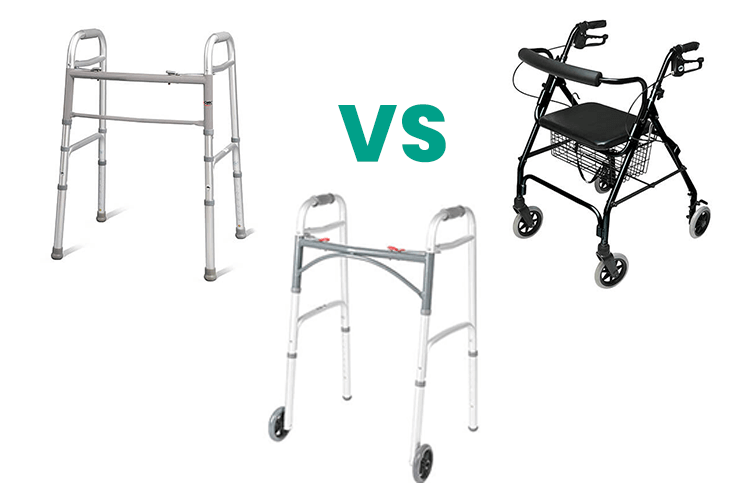
Walkers, like people, come in all shapes and sizes, and vary in quality. The old silver one with the wheels in the front and legs in the back is called a Rolling Walker. Four legs without wheels is a Standard Walker. (To save some time and energy, the only time a standard walker is going to the the ‘right answer’ is if you aren’t allowed to put full weight on your leg, or if you are missing a leg. Case Closed.) Despite the fact that we’ve developed crazy things like the INTERNET in the last hundred years, the design of these two basics actually haven’t changed much, if at all. These are the kinds of walkers you’ll come home from the hospital with if you’ve had a joint replacement or experience a fall and fracture. While the rolling walker has it’s time and place, and is certainly the safest option *in-home* for many people, it is not my favorite device. Using a rolling walker a) limits your speed (bad for brain = bad for gait), b) limits your trunk rotation and arm swing (again bad for brain = bad for gait) and c) frequently leads, in my opinion, to increased isolation because people often either don’t want to be seen by their neighbors and friends with a walker, or just find the darn thing cumbersome. I put *asterisks* around *in-home,* because my biggest walker pet-peeve is they are HORRIBLE for walking on most suburban streets and sidewalks. While they may work well l if you live in a brand new town with perfectly manicured roadways, where I live, between tree-roots and frost heaves, most areas I gait-train with patients are basically a head-over-heels situation waiting to happen. Watching a patient try to navigate uneven terrain with a rolling walker is not my favorite experience. Walkers don’t work on grass, they don’t work on sand, and in reality, they don’t work too well on sidewalks.
What is the best Walker to buy?
Enter the Rollator. Rollators get a bad rap because they move fast and because the brakes get loose, but I actually prefer to wean a patient onto a rollator when I can. Rollators, with their four wheels + hand brakes and a built-in chair, give a person an option for life outside of their home (in my humble opinion). Using a rollator, for most people, is more intuitive than a walker; it actually turns in a circle and makes turning corners way easier, it is smoother over uneven sidewalks, can actually go over grass - and my favorite, allows you the freedom to walk further because you have an option to sit and take a break when you need to! Rollators make great choice for someone who may be limited by balance, endurance, cardiopulmonary impairments or back pain, but who still would like to be able get out and about in their communities. Quick note about rollator quality: while the general ‘got it for free from a neighbor’ rollator may not be the best, when a patient can afford it, I usually recommend a sturdier model called the Nitro. It is heavier, but stronger, more secure and is like the SUV of rollators. (Nitro Walker)

Still wondering if a Cane or a Walker or Nothing at All is the right thing for you? Ask a PT:)
We are movement experts; our job is to help you find the safest way to navigate your environment while at the same time, giving you the maximum independence. For some, this may mean weaning off an assistive device; for others, it may means encouraging you to use one. The Cane Vs. Walker Showdown is rarely black and white. What may work in your home may not be what is best for use in the community. You may be able to use a Cane or Nothing at All during the day, but a Walker may be best at night. See, like I said…It Depends:)
About the author:
Dr. Katie Wadland, PT, DPT is the Owner and Primary Physical Therapist at Healthy Aging Physical Therapy. Healthy Aging Physical Therapy offers in-home Physical Therapy for older adults living in Melrose, Medford, Arlington, Stoneham, Winchester, Reading, Woburn, Wakefield and Lynnfield, Massachusetts. She is licensed to practice Physical Therapy in the State of Massachusetts (License #18193). She has over fourteen years of experience working with older adults with musculoskeletal and neurological impairments and advanced training in the care of people with Parkinson’s Disease, Spinal Cord Injury and Stroke.